About Lactarius repraesentaneus Britzelm.
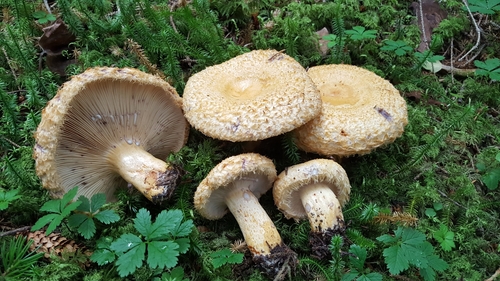
Lactarius repraesentaneus Britzelm. has a cap 6–18 cm (2.4–7.1 in) wide, ranging in shape from convex to broadly funnel-shaped. The cap margin, the outer edge of the cap, is noticeably bearded in young specimens. The cap surface ranges from faintly marked with concentric zones to completely unmarked, covered in a thin layer of matted fibers that often becomes scurfy as the mushroom ages. The surface is dry to somewhat sticky, colored light yellow to orange-yellow, and sometimes develops rusty tints in older specimens. The gills attach to the stem in a slightly decurrent arrangement, meaning they run slightly down the stem’s length. The gills are moderately broad, spaced close together to crowded, and are sometimes forked near the stem. Normally cream to pale ochraceous in color, they stain dull lilac to purple when bruised. The stem measures 5–12 cm (2.0–4.7 in) long and 1–3 cm (0.4–1.2 in) thick. It is roughly equal in width along its length or wider toward the base, becomes hollow when mature, and ranges from sticky to dry in texture. It is coarsely pitted (a feature called scrobiculate), colored pale yellow to orange-yellow, and also stains dull lilac to purple when damaged. The mushroom’s flesh is firm, brittle, and white, and stains dull lilac to purple when cut. The odor is sometimes faintly fragrant or unremarkable when fresh, but dried specimens have an intense soapy scent. The taste ranges from mild to slightly acrid or somewhat bitter, and its overall flavor has been compared to that of sweet flag (Acorus calamus). The mushroom produces abundant white to cream latex that does not change color when exposed, and stains all affected tissues dull lilac to purple. The latex also tastes mild to slightly acrid or somewhat bitter. The spore print of the species is yellowish. In 2011, a new form, Lactarius repraesentaneus f. immutabilis, was described from Le Sappey, located in the Haute-Savoie department of southeastern France. This form differs from the typical species in the staining reaction of its injured flesh. Spores of L. repraesentaneus measure 8–12 by 6.5–9 μm, and range in shape from broadly ellipsoid to ellipsoid. They are ornamented with warts and ridges that do not form a reticulum, with prominences up to 0.8 μm high. The spores are hyaline and amyloid. The cap cuticle is an ixocutis, meaning its hyphae are embedded in a slimy or gelatinized layer. Like other species in the genus Lactarius, L. repraesentaneus is thought to form mycorrhizal relationships with trees. This is a mutually beneficial relationship where the fungus’s hyphae grow around tree roots to form a protective tissue sheath. This arrangement lets the fungus receive moisture, protection, and nutrient byproducts from the tree, while the tree gains better access to nutrients from the soil. Fruit bodies of L. repraesentaneus grow scattered or in groups on the ground under spruce, appearing between August and September. In North America, the fungus is found at higher elevations in northern United States and southern Canada where spruce grows, and has also been reported from Alaska, California, and the Rocky Mountains. Its occurrence is described as occasional to fairly common in this region. In Europe, the species is fairly rare. It is found mainly under sallows (Salix capraea) in forests at the foot of mountains, growing on non-calcareous soil. Collections have been made in Czechoslovakia, Sweden, Switzerland, the French Alps, and England, and the species is widely distributed across the temperate zone of the northern hemisphere. It has also been collected under birch (B. pubescens, B. nana, and B. glandulosa) in Greenland. Fruit bodies of Lactarius repraesentaneus are considered poisonous, and consumption causes stomach aches. The identity of the toxic compounds responsible has not been identified.