About Lactarius pubescens Fr.
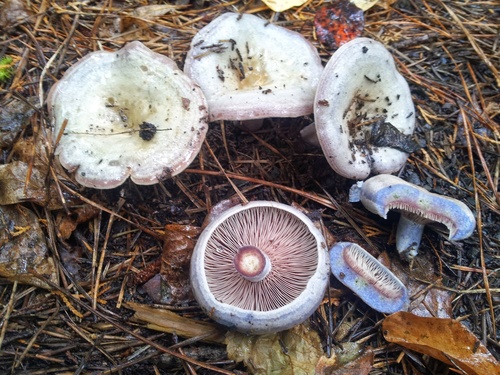
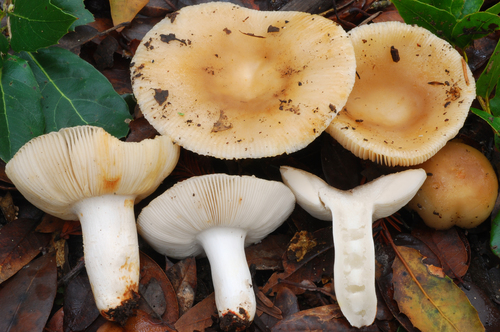
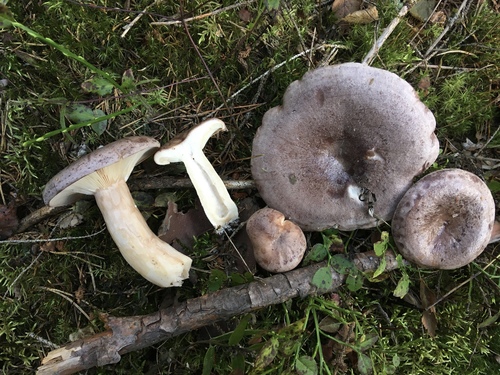
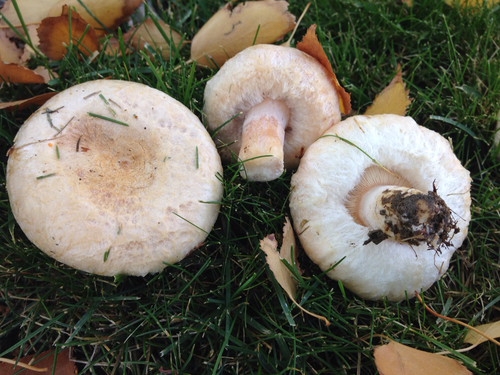
The scientific name of this fungus is Lactarius pubescens Fr. Its cap ranges from 2.5–10 cm (1.0–3.9 in) wide, starting obtuse to convex, and maturing into a broadly convex shape with a depressed center. When young, the cap margin (cap edge) curls inward and is bearded with coarse white hairs. The cap surface is dry and fibrillose across most of its area, except the center, which is sticky and smooth when fresh. The cap is azonate, colored white to cream, and develops reddish-orange to vinaceous (red wine-colored) tones on the central disc with age. The gills are attached to slightly decurrent, crowded, and seldom forked; they are whitish to pale yellow with pinkish tinges, and slowly turn brownish ochraceous when bruised. The stem measures 2–6.5 cm (0.8–2.6 in) long and 6–13 mm (0.24–0.51 in) thick; it is nearly equal in width or tapers downward, has a silky texture, becomes hollow with age, is whitish when young, and turns ochraceous upward from the base as it ages. The stem apex usually has a pinkish tinge, and the stem often bears a white basal mycelium. The flesh is firm and whitish; it has a faint odor resembling geraniums, or is sometimes pungent, and has an acrid taste. When exposed, the latex is white, remains unchanging, does not stain tissues, and has an acrid taste. The spore print is cream with a pinkish tint. Spores are 6–8.5 by 5–6.5 μm, elliptic in shape, ornamented with warts and ridges that sometimes form a partial reticulum, with prominences reaching up to 1.5 μm high; they are hyaline (translucent) and amyloid. The cap cuticle is made up of a layer of thin-walled hyphae. Sources have conflicting reports on the edibility of Lactarius pubescens, describing it as unknown, poisonous, and even edible. Fruit bodies of L. pubescens grow scattered or in groups on the ground in wet areas under birch and other hardwoods, appearing from August to October. The fungus is common across temperate Europe, and has been reported from eastern North America, the Pacific Northwest, Arizona, California, Colorado, Idaho, and western Canada, where it occurs occasionally. It is also found in Greenland, and was first reported in Rome, Italy, in 1997.