About Lactarius porniniae Rolland
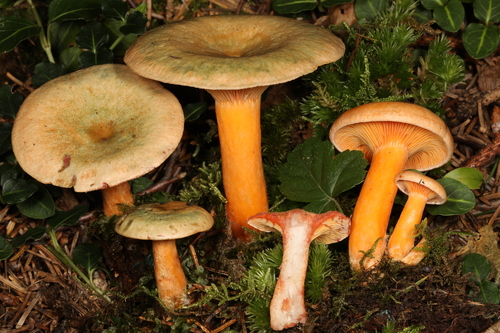
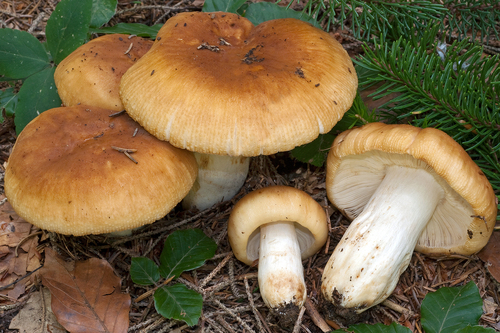
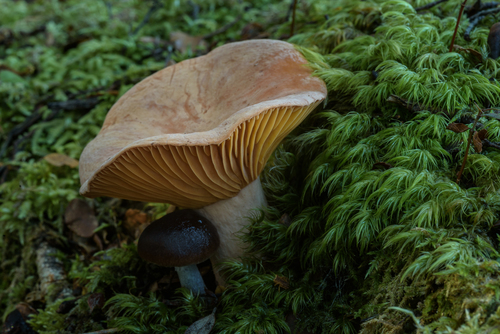
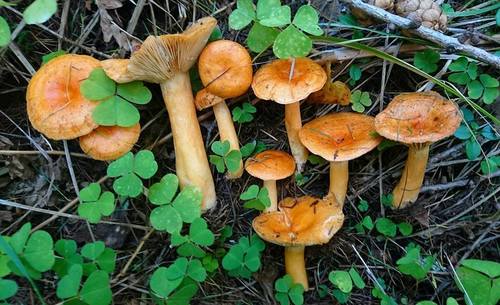
Lactarius porniniae Rolland has a cap that starts hemispherical with an inward-rolled margin, and later flattens into a convex or flat shape with a depressed center and a slightly upward-curving margin. The cap reaches 3–13 cm (1.2–5.1 in) in diameter. Its surface has a felt-like texture and is slightly sticky to touch, colored orange to yellow-brown or orange-brown, with concentric rings that are palest near the margin. The thin, crowded gills attach to the stipe in an adnate to slightly decurrent arrangement, and are pale pinkish-buff in color. The cylindric stipe is 2–9 cm (0.8–3.5 in) long by 0.7–2.5 cm (0.3–1.0 in) thick, tapering slightly near both the top and base. It has a smooth surface, and ranges in color from pale cream to pinkish-buff. The spore print of this species is cream. Its spores are ellipsoid, measuring 6.3–9.6 by 5.2–7.3 μm, with an incompletely reticulated surface featuring ridges up to 0.5 μm high. The spore-bearing basidia are somewhat club-shaped, four-spored, and measure 40–50 by 10–13 μm. Lactarius porniniae forms mycorrhizal associations with larch. It is common in mountain forests of central Europe, where it fruits from July to November. In Asia, it has been recorded in China and Japan.