About Lactarius argillaceifolius Hesler & A.H.Sm.
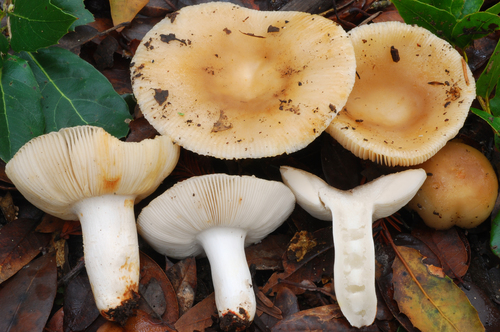
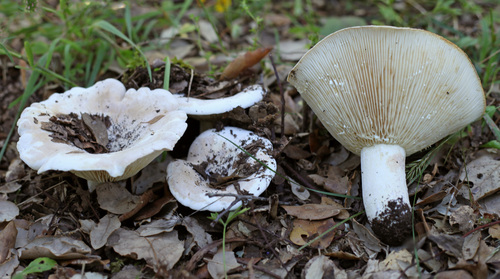
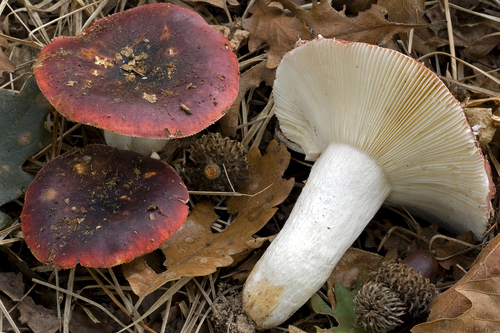
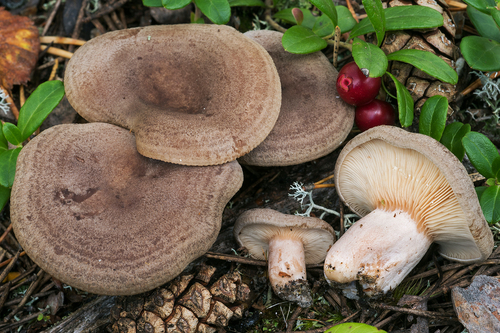
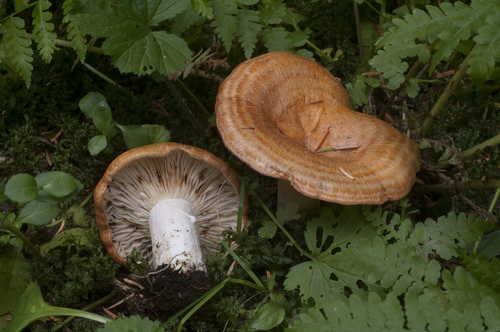
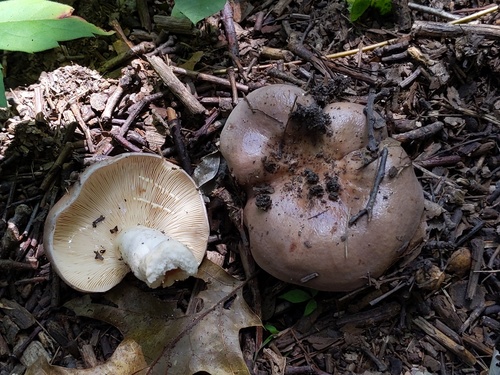
Lactarius argillaceifolius Hesler & A.H.Sm. has a cap that ranges 4–20 cm (1.6–7.9 in) wide. It is initially convex to broadly convex, then flattens out with a depressed center. The cap margin curves inward, often remaining this way even when the mushroom reaches maturity. When young, the cap surface is covered with fine soft hairs, and it becomes smooth with age; it is slimy and sticky when wet. Young cap color is lilac-brown, fading to lilac-tan or pale lilac-gray, and eventually becoming pale tan or pinkish-buff at the center. The gills are attached to slightly decurrent (extending somewhat down the stem), broad, and closely packed. They are cream-colored when young, and later develop pinkish tones near the margin, becoming fully flushed with brownish-orange when mature. Bruising the gills causes staining in shades ranging from buff to olive-brown to dark brown. The stem measures 3–15 cm (1.2–5.9 in) long and 1–5 cm (0.4–2.0 in) thick, and is roughly equal in width along its length or tapers downward. Depending on environmental moisture, the stem surface may be slimy or dry. It is whitish, and develops brownish stains in spots as it ages. The flesh is firm, and colored white to buff. It does not have a distinctive odor, and its taste is mild or slowly becomes slightly acrid. When first exposed, latex is creamy-white, and it stains gills grayish-brown to dark brown or olive-brown; the latex also tastes mild or slowly becomes slightly acrid. Older fruit bodies tend to have less abundant latex with a weaker taste. The spore print of this species is yellowish to pinkish-buff. The edibility of L. argillaceifolius is unknown. A drop of dilute potassium hydroxide applied to the cap surface will turn it yellow to orange. Microscopically, the spores are roughly spherical to broadly elliptical, measuring 7–11 by 7–8 μm. They are ornamented with warts and ridges that sometimes form a partial reticulum, a pattern of interconnected ridges, with prominences reaching up to 1 μm high. The spores are hyaline (translucent) and amyloid, meaning they absorb iodine when stained with Melzer's reagent. Young specimens have a cap cuticle made of an ixotrichoderm, a tissue containing gelatinized hyphae of varying lengths arranged roughly in parallel. As the mushroom matures, the cap cuticle gradually changes to an ixolattice, which is characterized by branching, entangled gelatinous hyphae. The spore-bearing basidia are four-spored, and measure 45–52 by 9–10.5 μm. Pleurocystidia, cystidia found on the gill face, are abundant and relatively long, measuring between 60 and 140 μm long by 6–14 μm thick. Cheilocystidia, cystidia found on the gill edge, measure 32–67 by 6–9 μm. Like all Lactarius species, L. argillaceifolius is mycorrhizal. Its fruit bodies grow scattered or in groups on the ground under hardwood trees, especially oak, from July to October. It is often one of the first mycorrhizal mushrooms to fruit in forests dominated by oak and hickory. Its fruit bodies develop slowly and are long-lasting. The main range of the species extends from eastern Canada south to Florida, and west to Minnesota and Texas, and it is common in northeast Mexico. It has also been reported from southern Brazil in the state of Santa Catarina, where it grows in association with plantations of Pinus elliottii, and was probably introduced with pine seedlings brought by settlers. The variety L. argillaceifolius var. megacarpus has been collected in Baja California, California, Oregon, and Washington, where it grows in association with coast live oak and tanoak.