About Lachnagrostis filiformis (G.Forst.) Trin.
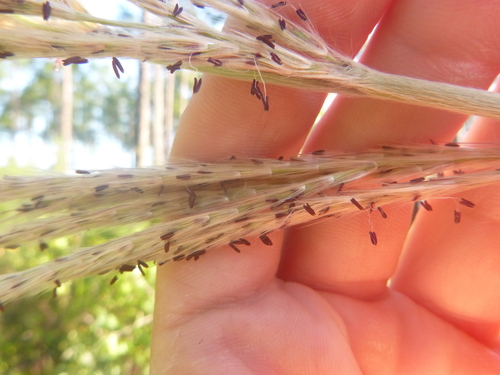
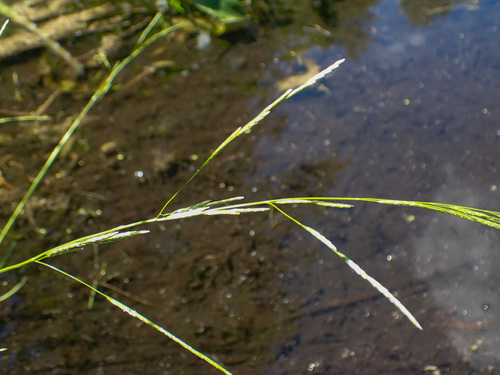
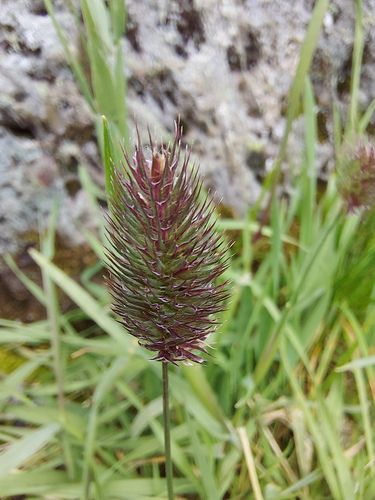
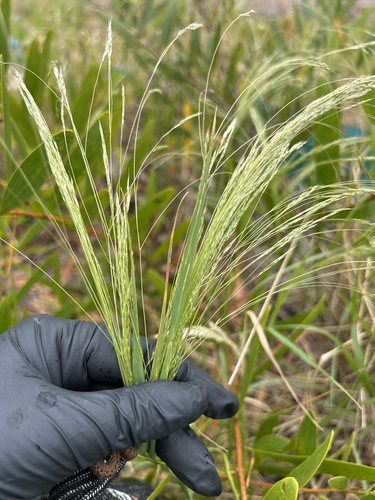
Pacific bent grass (Lachnagrostis filiformis (G.Forst.) Trin.) is a tufted perennial grass that grows up to 65 centimeters tall. Its leaf blades are flat, measuring around 8 to 25 centimeters long and 2 to 3 millimeters wide. The stems are round or polygonal and hollow. The inflorescence emerges in June and July, and ranges from 7 to 30 centimeters long. It takes the form of a panicle made up of wispy strands, each bearing several tiny, fuzzy spikelets at the tip. The spikelets are two or three millimeters long, with geniculate awns and hairy lemmas. L. filiformis is similar to L. littoralis, a species endemic to New Zealand, and both share geniculate awns and intravaginal branching. L. filiformis can be distinguished by the primary and secondary branches of its panicle, which are obviously unequal in length. This species is native to Australia, New Zealand, and other Pacific Islands including New Guinea and Easter Island. In New Zealand, it is scattered across the North and South Islands, growing mainly near the coast and on inland lake margins. It also occurs on the Kermadec Islands, Three Kings Islands, Stewart Island, and Chatham Island. It has been introduced to southern Africa, the United Kingdom, Taiwan, the southern United States, and Mexico. In New Zealand, L. filiformis grows most often on damp ground like lake margins, as well as on disturbed ground and roadsides. It is usually found in lowland areas, but occasionally occurs in montane regions. It also frequently acts as an urban weed, growing on waste ground around settlements and in muddy ground. It is thought to have expanded its range following human settlement. L. filiformis has a high salt tolerance.