About Lachesis muta (Linnaeus, 1766)
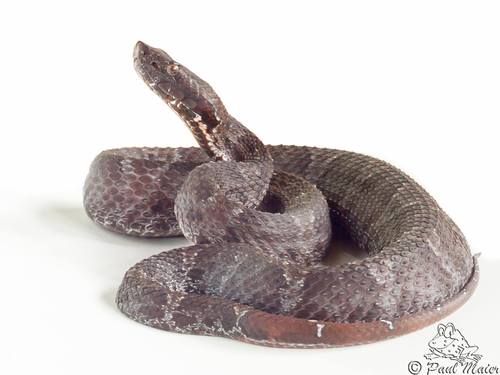
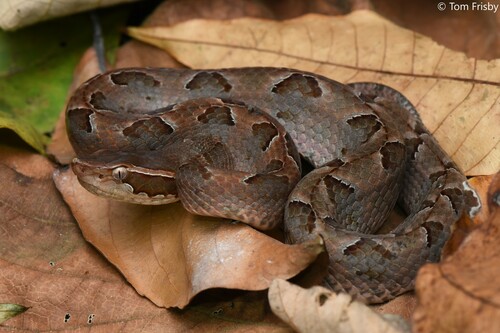
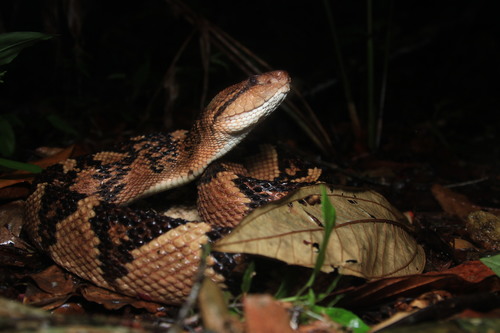
On average, adult Lachesis muta reach 2 to 2.5 meters (6½ to 8 feet) in length, and individuals reaching 3 meters (10 feet) are not uncommon. The largest confirmed specimen on record measured 3.65 meters (12 feet) long. This makes Lachesis muta the longest viper species overall, and the longest venomous snake native to the Western Hemisphere. It ranks as the third longest venomous snake species in the world, with only the king cobra and black mamba growing to longer lengths. The average body weight of this species is estimated at 3 to 5 kg (6.6 to 11.0 lb), which is somewhat less than the weight of the heaviest rattlesnakes like the eastern diamondback rattlesnake, and less than the weight of Bitis vipers including the Gaboon viper and rhinoceros viper. The head of Lachesis muta is broad and clearly distinct from the narrow neck. The snout is broadly rounded, with no distinct canthus. A pair of small internasal scales is present, separated from one another by small scales. The supraocular scales are narrow, and all other scales covering the crown of the head are very small. Along the side of the head, the second supralabial scale forms the anterior edge of the loreal pit, while the third supralabial scale is very large. The eye is separated from the supralabial scales by 4 to 5 rows of small scales. The body is cylindrical, tapered, and moderately stout. At midbody, there are 31 to 37 nonoblique rows of dorsal scales; these scales are heavily keeled with bulbous tubercles, and are feebly imbricate. This species has 200 to 230 ventral scales. The tail is short, with 32 to 50 mostly paired subcaudal scales, followed by 13 to 17 rows of small spines ending in a terminal spine. Like most New World pit vipers, Lachesis muta performs defensive tail vibration behavior when responding to potential predators. The species' color pattern has a yellowish, reddish, or grey-brown base ground color, overlaid with a series of dark brown or black dorsal blotches. These markings form lateral inverted triangles of the same dark brown or black color. Lateral patterning may be clearly or vaguely defined, and the center of these markings is normally pale. Lachesis muta is distributed in South America, where it occurs in equatorial forests east of the Andes Mountains, as well as on the island of Trinidad. Its type locality is listed as Suriname (originally noted as "Surinami"). It inhabits both primary and secondary forests, as well as adjacent fields and cleared areas. On the island of Trinidad, this species typically prefers hilly and mountainous regions.