About Lacerta viridis (Laurenti, 1768)
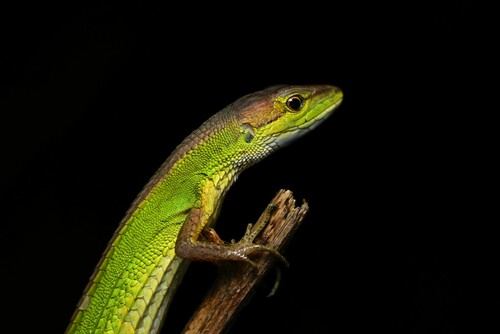
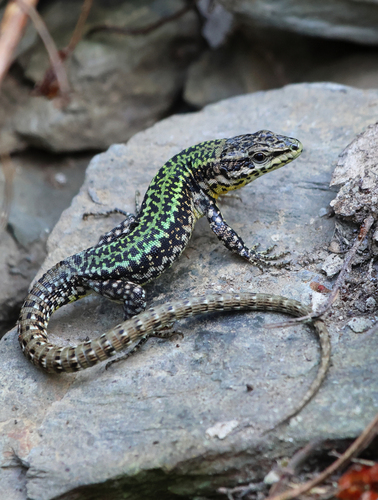
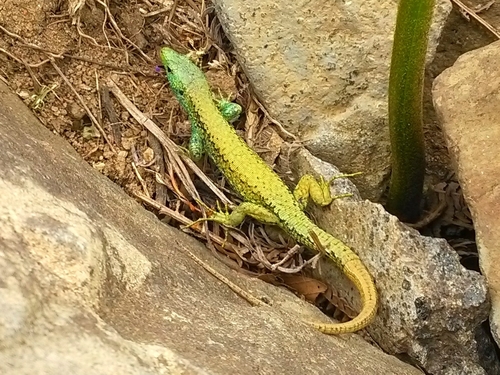
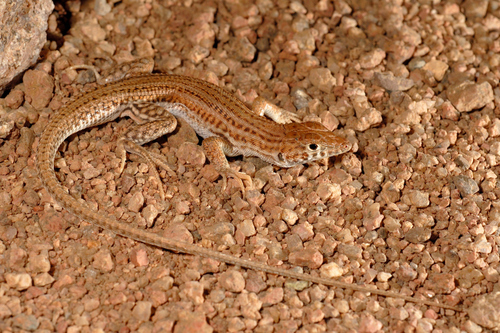
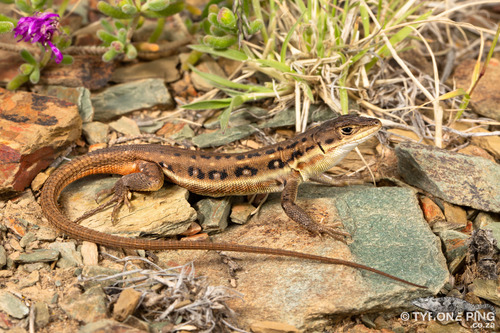
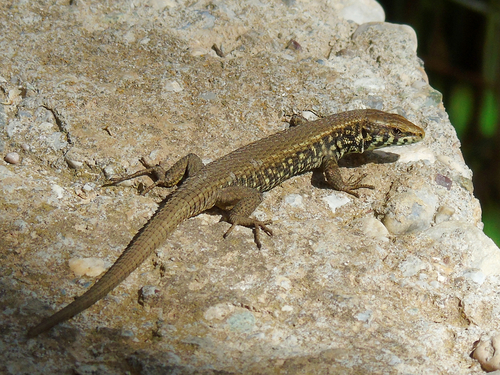
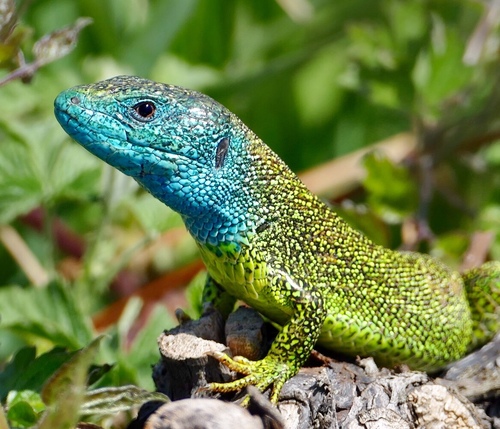
This species, the European green lizard with the scientific name Lacerta viridis (Laurenti, 1768), measures up to 15 cm (5.9 in) from the tip of the muzzle to the cloaca. Its tail can grow up to twice the length of its body, bringing the total maximum body length to 40 cm (16 in). This lizard sometimes sheds its tail, a process called autotomy, to escape a predator's grasp, and regrows the tail later. Males have larger heads, with a uniform base green color marked by small spots that are more distinct on the back. Adult males have a bluish throat, and females have a less prominent bluish throat. Females are more slender than males, have more even body coloration, and often display between two and four light bands bordered by black spots. The European green lizard is native to southeastern Europe. Its distribution ranges from southern Germany, Austria, Hungary, the Czech Republic, Slovakia, extreme northeastern Italy, Slovenia, Croatia, Bosnia & Herzegovina, Serbia, Montenegro, Albania, North Macedonia, and Greece, extending south and east to southern Ukraine, Romania, Bulgaria, and western Turkey. It can be found at elevations up to 2,200 m (7,218 ft) above sea level. Its typical habitat is dense bushy vegetation growing in open woodland, hedgerows, field margins, embankments, and bramble thickets. In the northern portion of its range, it may occur on bushy heathland, and in the southern portion, it prefers damp locations. Multiple attempts to introduce green lizards to Britain have been made since the late 19th century; a colony identified as L. bilineata has persisted at Bournemouth since the late 1990s. L. bilineata is also found in Jersey, Channel Islands, where it may be native. The species has been introduced to the state of Kansas in the United States.