About Lacerta agilis Linnaeus, 1758
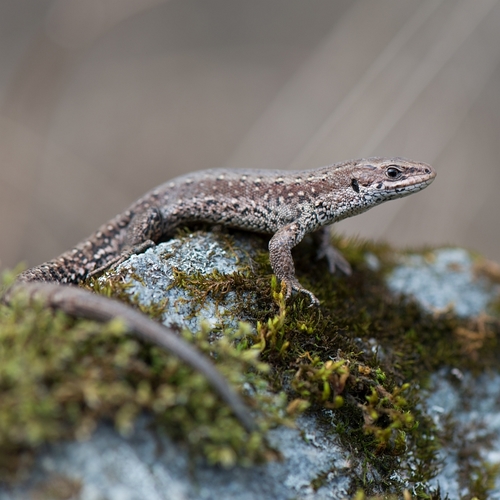
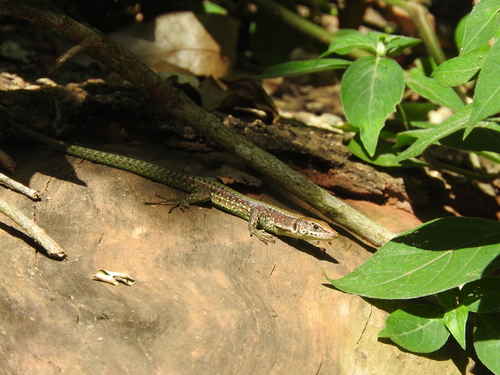
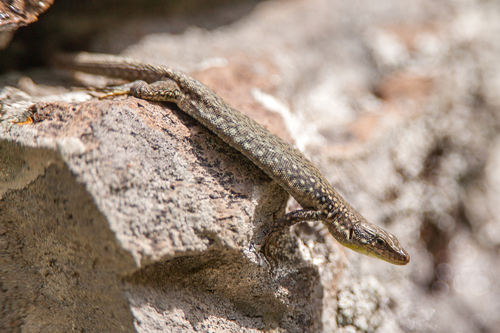
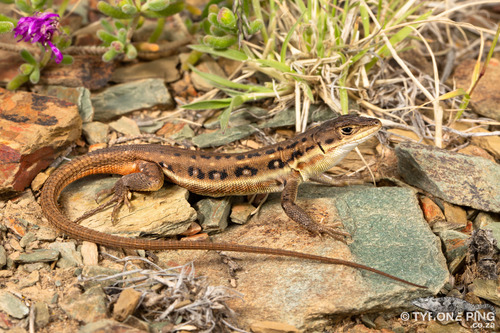
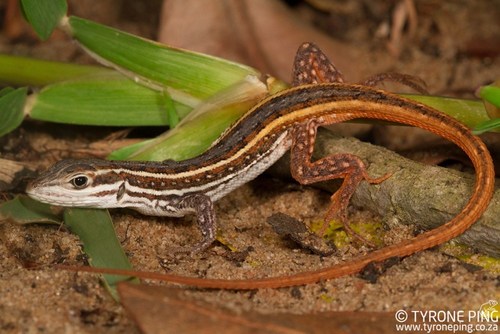
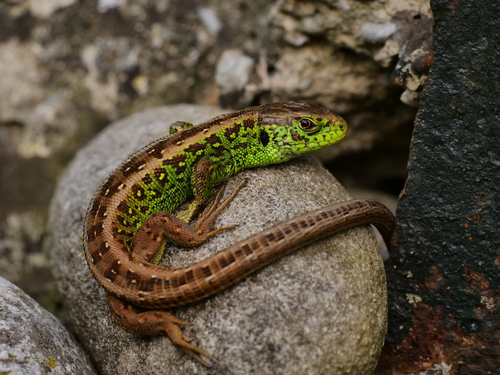
This species, Lacerta agilis, commonly called the sand lizard, is a sexually dimorphic legged lizard. Across its range in Europe and Russia, sand lizard coloration varies. In northwest Europe, both sexes have dorsal and lateral rows of ocellated, eye-shaped markings: dark patches with pale centres. Males have finer markings than females; during the spring mating season, their flanks turn bright green, which fades again by late summer. Adult males can reach a total body length of 19.3 cm, while adult females can reach 18.5 cm. The two main western subspecies are L. a. agilis and L. a. argus. In these two subspecies, the dorsal stripe is thin and interrupted, or absent entirely. L. a. argus also has a plain red or brown-backed phase with no dorsal markings. In these western subspecies, only males' flanks turn green during mating season. In the predominantly eastern subspecies L. a. exigua, males can be entirely green even outside the breeding season. Sand lizards can self-amputate their tails for defense, an ability called autotomy. In males, brighter green genital coloration correlates with higher body mass and greater fighting ability; males with brighter coloration are more likely to initiate aggressive behavior and win fights, which typically gives them higher mating success. Females are usually grey to brown in color, and can be seen with large bulging bellies full of eggs between May and August. Sand lizards can live for over ten years, with an average lifespan of 5 to 6 years. Sand lizards occupy a variety of habitats, and prefer dry habitats including outcrops, fields, hills, beaches, heathland, sand dunes, and rock gardens. In continental Europe, the sand lizard uses a wide diversity of habitats. In colder locations like Great Britain, sand lizards depend on sand to incubate their eggs, so they are restricted to coastal habitats. Male sand lizards have home ranges with extremely high overlap. In contrast, female sand lizards have much smaller home ranges, generally less than 100 square meters, that adjoin each other, and females may even share burrows or basking areas with one another. Sand lizards strongly prefer and are most active in areas with a wide range of structural characteristics, which create different temperature microhabitats they can move between to match their needs. Males generally reach sexual maturity at a smaller size than females. For the entire population, vitellogenesis in females takes 45 days. Both sexes tend to lose body fat during the mating period, as they draw most of their energy from body fat stored in the liver and proximal portion of the tail. A few weeks after emerging from hibernation, adult males become extremely aggressive toward each other, and attempt to mate with as many females as possible. Female sand lizards lay eggs in loose sand in a sunny spot, leaving the eggs to be incubated by geothermal warmth. Most females lay only a single clutch each year, with clutch sizes ranging from six to 15 eggs per clutch. There is substantial variation in the time of year females lay their eggs, but individual females typically have relatively consistent egg-laying timing from year to year. Larger, more physically fit females generally lay eggs earlier than other females. Early clutches produce larger offspring that are more successful and have higher survival rates; overall, offspring from earlier clutches are higher quality. When a female sand lizard produces a larger clutch size, each individual offspring in the clutch is smaller. Conversely, smaller clutches produce fewer but larger offspring. When food resources are increased and no longer a limiting factor, clutch size increases significantly. This suggests sand lizards adjust clutch size and individual offspring size based on available resources. Physical constraints on the space available for clutches are an additional contributing factor.