About Laccaria amethystina Cooke
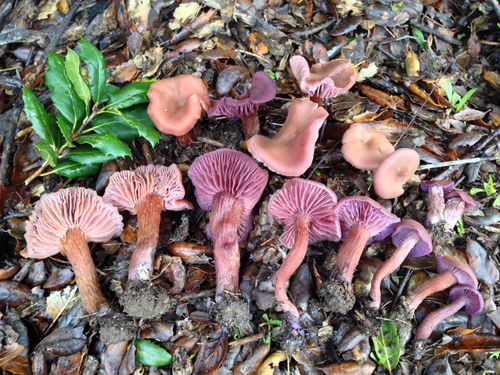
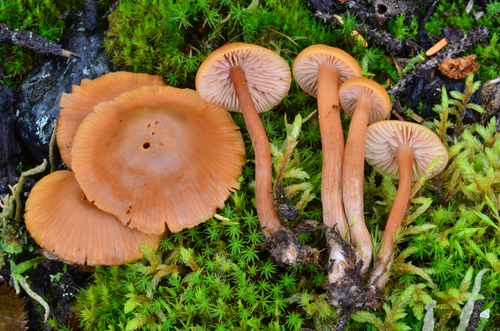
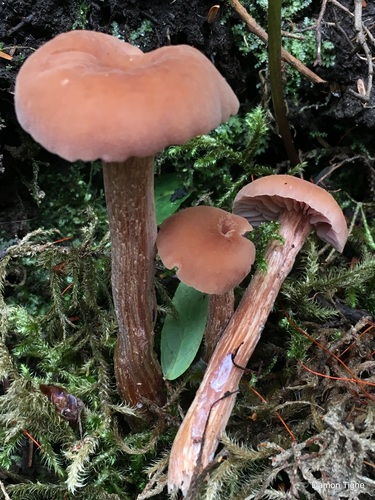
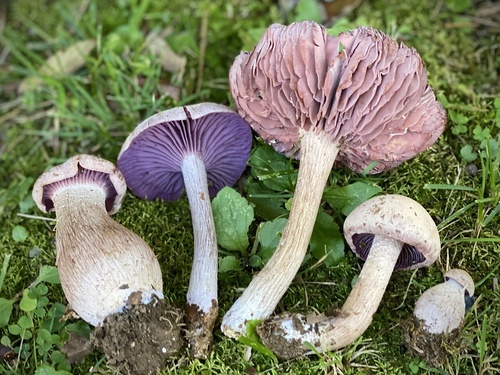
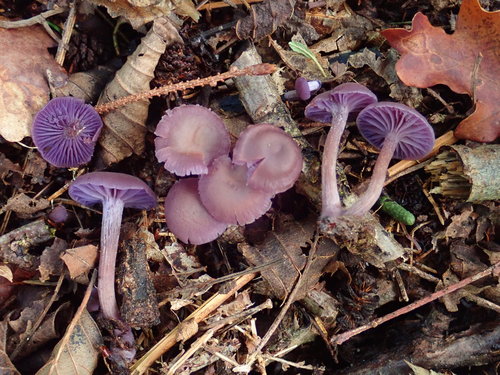
Laccaria amethystina Cooke has a cap that reaches up to 6 centimetres (2+1⁄4 in) in diameter. The cap starts out convex, then flattens as it matures, and usually has a central depression (navel shape). When moist, the cap is a deep purplish lilac, and this colour fades when it dries out. The centre of the cap is sometimes slightly scurfy, and the margin has pale striations. The stem matches the cap in colour, with whitish fibrils at its base that become mealy toward the top of the stem. The stem is fibrous, hollow, and fairly tough when rolled between fingers, and measures 0.6 to 7 cm (1⁄4 to 2+3⁄4 in) long by 0.1 to 0.7 cm (1⁄16 to 1⁄4 in) thick. The thin flesh has no distinctive taste or smell, and is pale lilac in colour. The gills share the cap's colour, are usually quite widely spaced, become dusted with the fungus's white spores, and attach to the stem in a sinuate pattern, meaning they have a concave indentation just before attaching to the stem. Microscopically, the spores are spherical, hyaline, and echinulate (covered with pointed spines that are long relative to the size of the spore). Spores typically measure 7–10 by 7–10 μm. The spore-bearing basidia are club-shaped, hyaline, and measure 30–64.5 by 8.5–14 μm. This species is common in most temperate zones of Europe (where it occurs from June to December), Asia, Central America, South America, and eastern North America. It grows from solitary to scattered, and forms mycorrhizal associations with a wide variety of deciduous and coniferous trees, though it most commonly associates with trees in the order Fagales. It appears from late summer to early winter, and often grows with beech. In Central and South America, it more commonly grows in association with oak. Research has identified L. amethystina as an ammonia fungus, an ecological classification for fungi that grow abundantly on soil after ammonia or other nitrogen-containing materials are added. Laccaria bicolor, a species in the same genus as L. amethystina, is also an ammonia fungus.