About Laccaria amethysteo-occidentalis G.M.Muell.
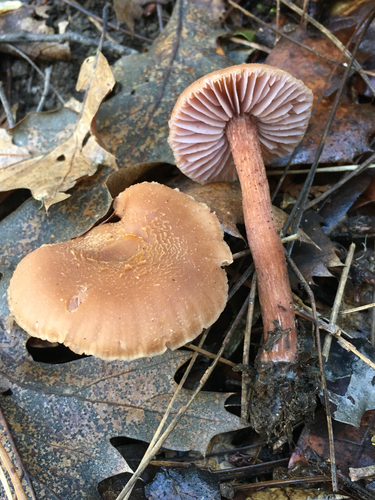
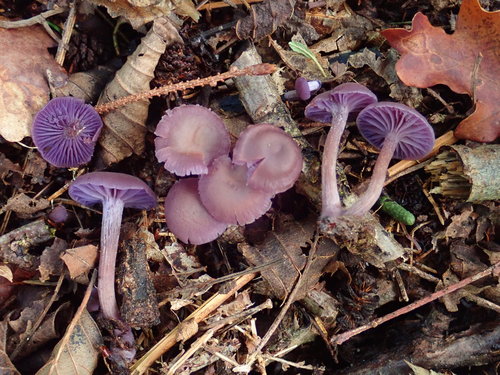
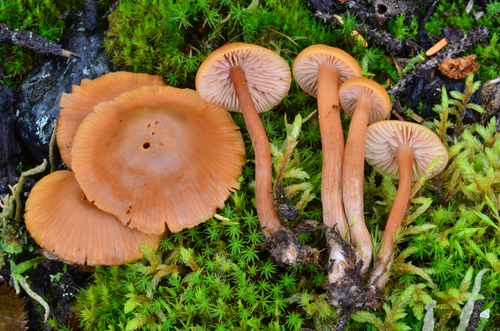
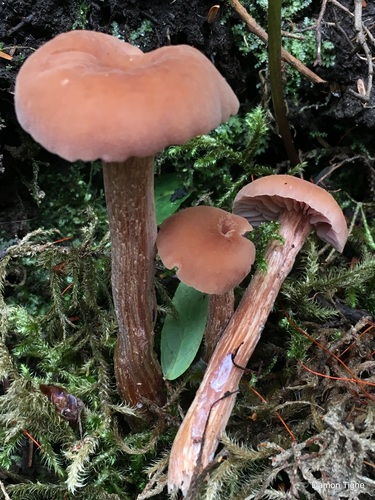
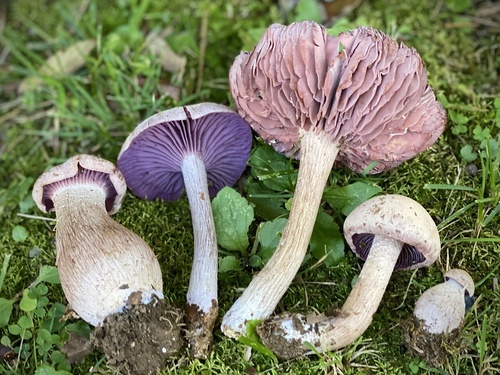
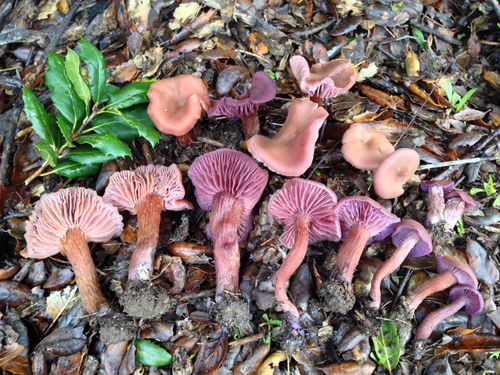
This mushroom species, Laccaria amethysteo-occidentalis G.M.Muell., is entirely purple. Its cap measures 1 to 7 centimeters (1⁄2 to 2+3⁄4 inches) wide, is broad and ranges in shape from convex to flat, and is often depressed. When the mushroom fades, the cap may occasionally become slightly translucent-striated; it is finely fibrillose, hygrophanous, and fades to a violet color. The cap margin is rolled inward when young, and becomes flat with age. The internal context of the mushroom is thin and a lighter grayish-purple. The gills are purple, thick, and distantly spaced. The stem grows up to 14 cm (5+1⁄2 inches) long, is fibrous, and has whitish mycelium near its base. Spores of this species measure 7.5–10.5 by 7–16 μm, and are subglobose or broadly elliptical; the spore print is white. Basidia measure 34–56.5 × 9.7–14.7 µm, and are clavate, elongate, and hyaline. Pleurocystidia are absent. Cheilocystidia measure 36.5–66.5 × 12–18.4 µm, and are subclavate to clavate, thin-walled, and hyaline. They are often very abundant, and extend well beyond the basidia. This species is found growing on the ground near the North American West Coast, where it occurs from October to February. It is an edible mushroom with good texture, but has little flavor.