About Lacanobia suasa (Denis & Schiffermüller), 1775
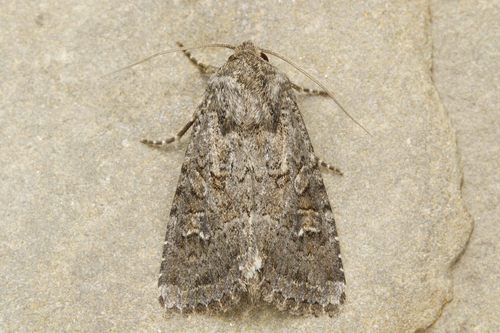
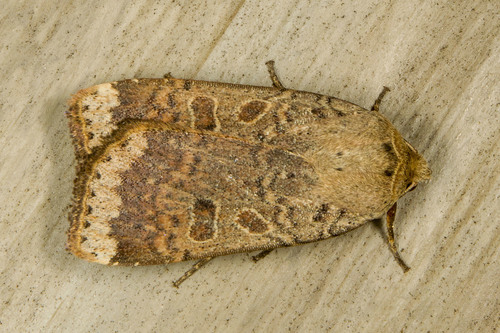
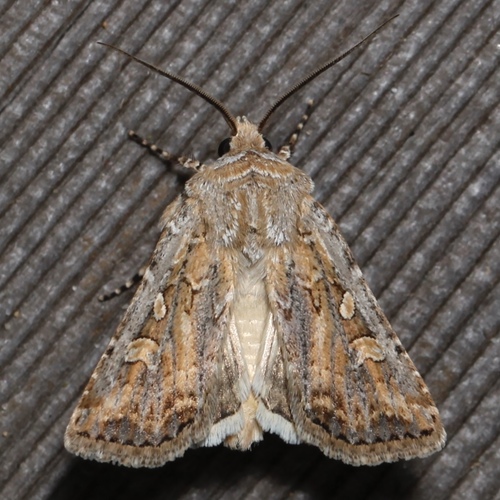
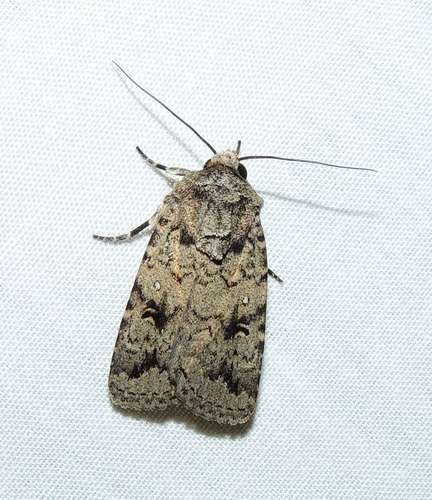
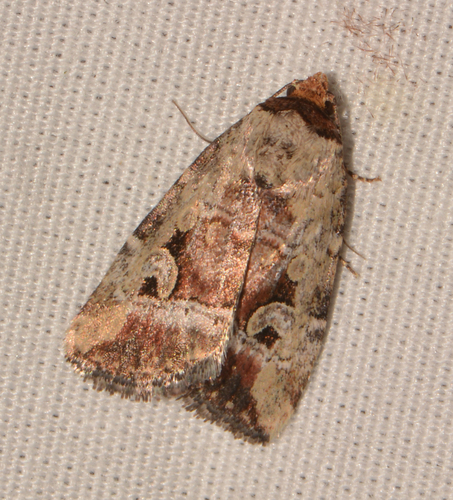
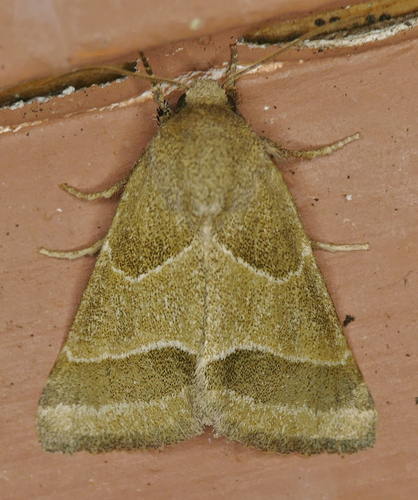
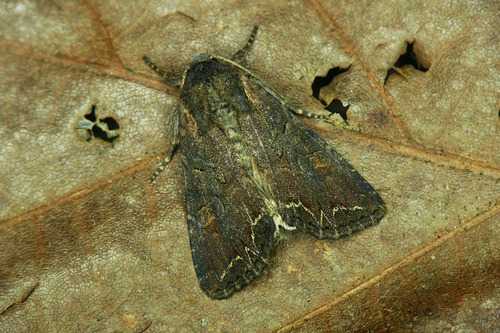
Technical description and variation. The wingspan of Lacanobia suasa is 32–37 mm. The forewing is pale ash grey, suffused with olive brown, with a black streak extending from the base below the cell. Some individuals have a uniformly dull red brown forewing, where all markings are obscured; even the black basal streak is sometimes obsolete, along with the typically distinct pale submarginal line with its two sharp teeth on veins 3 and 4. The hindwing is dull fuscous, paler toward the base, with darker veins. The form suasa Bkh. [sic] is the most common, and is pale leatherbrown with distinct markings: a black basal streak, blackish claviform stigma, a dark cloud at the lower end of the cell, a black marginal area, and paler upper stigmata. The form laeta Reuter, originating from Scandinavia, Finland, and the Baltic coast (but also found elsewhere), is an extreme variant of this common form; it has a pale patch at the base of the costa and black wedge-shaped marks preceding the pale submarginal line. The form confluens Ev. is the darkest variant, entirely blackish fuscous, with markings only faintly outlined, and the submarginal line sometimes broken into separate dots. The variant ab. turanica Spul, a pale greyish-red form from Turania, has more or less obsolete markings, but keeps a distinct submarginal line. Finally, the variant extincta Stgr. from Amurland is also a dark form, with pale yellow markings instead of pale white markings.