About Labrus viridis Linnaeus, 1758
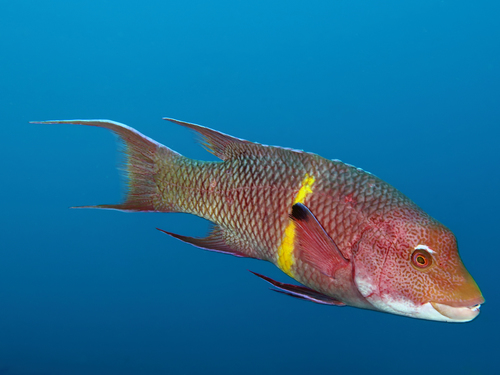
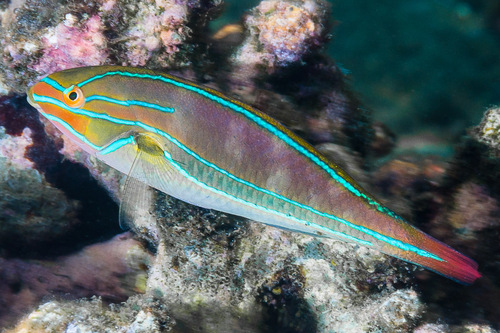
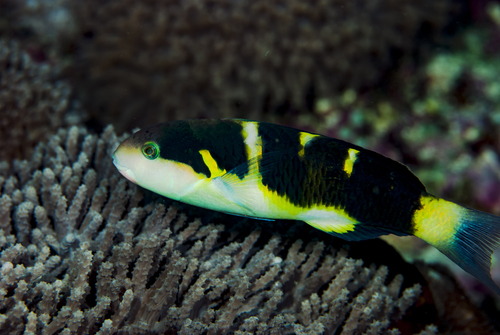
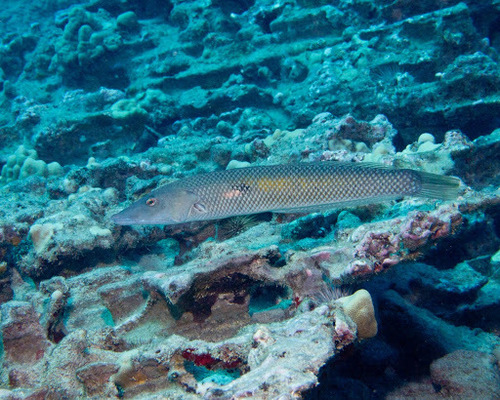
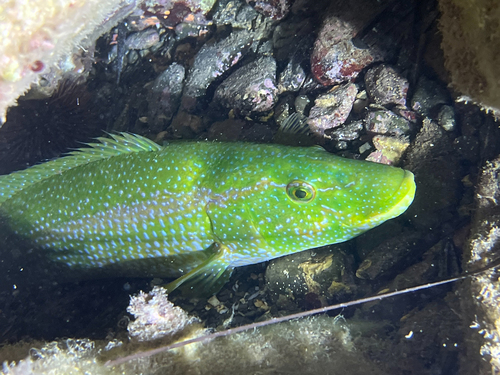
Labrus viridis, the green wrasse, grows to around 35 cm (14 in). It is a plump fish with a moderately large head, large eyes, and nostrils that each have a double opening. It has thick lips, a fairly small mouth, and numerous large teeth. Its back is slightly humped, and its belly is slightly convex. The skin is covered in large scales, and feels smooth and soft because it is coated in mucus. The dorsal fin has 18 spines and 12 soft rays. The pectoral fins are large, and the caudal fin is undivided. Most individuals are bright green with a blue line along the flank, but some are almost entirely black, and others have spots. The green wrasse is native to the eastern Atlantic Ocean between Portugal and Morocco, and most of the Mediterranean Sea. It is apparently absent from the coastal waters of Syria, Lebanon, and Israel. It is also found in the western Black Sea. It occurs at depths down to about 50 m (160 ft). Its typical habitats are areas around rocky reefs (especially reefs thickly covered in seaweed) and seagrass meadows. Green wrasse may form small groups, but are more often found alone or in pairs. They feed on small fish, crustaceans, and other invertebrates. The species is thought to be a protogynous hermaphrodite: individuals start life as females, and later change sex to become males. As a result, males are typically larger than females. A breeding pair prepares a dish-shaped nest within vegetation. After the female lays adhesive eggs, the male guards and cares for them. Green wrasse likely reach sexual maturity at three years old, and may live up to twenty years.