About Labrus mixtus Linnaeus, 1758
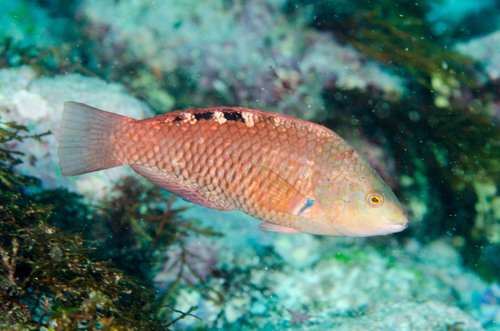
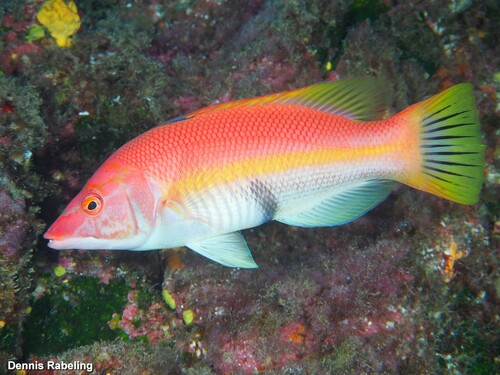
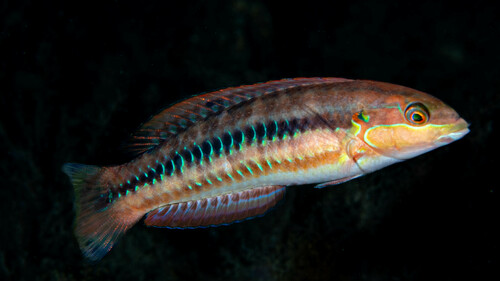
This fish species, Labrus mixtus Linnaeus, 1758, is commonly called the cuckoo wrasse. It has a long, pointed head, with a slimmer, more elongated body shape than the ballan wrasse Labrus bergylta, which it shares a range with in the northeastern Atlantic. Cuckoo wrasse are very colourful and display clear sexual dimorphism. Young males and females have a mixed colouration of pink, orange and red. Females have three black spots on their back to the rear of the dorsal fin, with white colouration between the spots that stretches to the tail; these markings are not present on males. Males have blue heads and orange bodies, with blue stripes and mottled patterns running along the body, and blue lines along the margins of the fins. Like the ballan wrasse, the cuckoo wrasse has a small mouth with thick, fleshy, folded lips, and a single row of canine-like teeth in each jaw. The maximum recorded total length for a male is 40 centimetres (16 in), and 30 centimetres (12 in) for females; the common total length for males is 30 centimetres (12 in). Its long dorsal fin maintains an even height along its entire length, and this species has large scales that are bigger than the pupil of the eye. The cuckoo wrasse is distributed across the northeastern Atlantic Ocean, along the European coast from Norway south to Andalusia, and along the Atlantic coast of North Africa south to Senegal. It can also be found off the Canary Islands, the Azores, and Madeira. Its range extends into the Mediterranean Sea as far east as Cyprus, where it is common, but it is not present in the Levantine Sea. Cuckoo wrasse live in areas with rocks and other hard substrates in the algal zone at depths between 2 and 200 metres (6 ft 7 in to 656 ft 2 in), though they are most frequently found between 20 and 80 metres (66 to 262 ft). They are also associated with areas dominated by coralline algae. This species prefers slightly deeper water than the sympatric ballan wrasse off western Europe, and only occasionally enters very shallow inshore waters. In the Azores, adult cuckoo wrasse are normally not found at depths shallower than 50 metres (160 ft), though juveniles may occasionally be found at shallower depths. Cuckoo wrasse typically occur as solitary individuals, or in pairs that include young fish. They are oviparous; the female can lay up to one thousand eggs in a dish-shaped nest that the male constructs from algae, and the male guards the nest after laying. The cuckoo wrasse is a protogynous hermaphrodite, meaning females can change sex to become males, a process that takes around seven months. Its diet consists mainly of crustaceans, but it will also feed on fish, molluscs, and worms.