About Labroides phthirophagus Randall, 1958
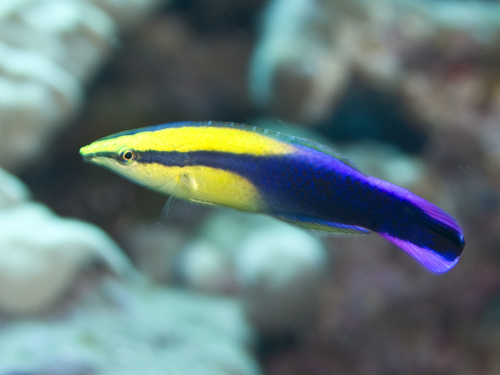
Description: The Hawaiian cleaner wrasse reaches a maximum length of about 12 cm (5 in). It has distinct striking coloration: the front anterior part of the body is golden, with a dark lateral stripe running from the eye to the tail that grows wider toward the back. The rear posterior part of the fish, including its fins, has purple and violet coloring. Distribution and habitat: This fish is endemic to the Hawaiian Islands and nearby Johnston Atoll. It typically inhabits coral and rocky reefs, and avoids the surge zone. It occurs at depths down to approximately 90 m (300 ft). Ecology: The Hawaiian cleaner wrasse moves with a graceful flitting motion. At night, it often rests in a balloon-like cocoon that it builds from mucus. The species is monogamous, and a pair bond forms during the breeding season. It is an obligate feeder that relies entirely on ectoparasites from other fish, and will not thrive in aquariums that cannot meet this specialized feeding requirement. Its behaviour is very similar to that of the closely related bluestreak cleaner wrasse (Labroides dimidiatus), which is widely distributed across the rest of the Indo-Pacific region. Both species maintain cleaning stations, where larger client fish come to have their ectoparasites, loose skin flakes, and mucus removed by the cleaner wrasse. This is a mutually beneficial arrangement: client fish get their parasites removed, and the wrasse gets food and protection. The relationship is not risk-free for the cleaner wrasse, as many client fish are piscivores. However, wild observations show almost no cheating by client fish eating the cleaner, as clients seem to appreciate the tactile stimulation from the cleaner moving across their skin and fins. Cleaner fish appear to build relationships with their clients, and communication occurs between them. When a new client arrives at a cleaning station, it first observes the cleaner's activity. If the cleaner is already with another client, the new client watches for jolting twitches from the existing client that occur when the cleaner cheats by biting the client's scales or mucus. If such cheating is observed, the prospective client will leave. If the prospective client is satisfied with what it sees, it holds a species-specific pose that invites the cleaner to begin cleaning.