About Labroides bicolor Fowler & Bean, 1928
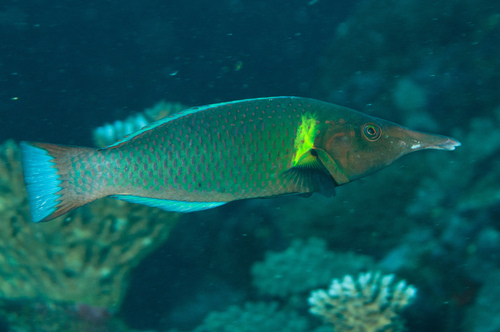
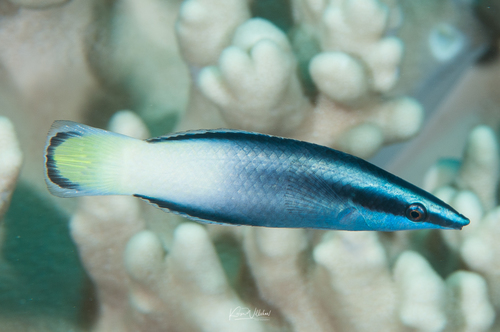
Male bicolor cleaner wrasses, Labroides bicolor, are black with pale coloration on the rear of their bodies. Females are gray with black patterning, while juveniles have yellow and black coloration. This species is found across the following countries and territories: American Samoa, Australia, British Indian Ocean Territory, China, Christmas Island, Cocos Islands, Comoros, Cook Islands, Fiji, French Polynesia, Guam, India, Indonesia, Japan, Kenya, Kiribati, Madagascar, Malaysia, Maldives, Marshall Islands, Mauritius, Mayotte, Micronesia, Mozambique, Myanmar, Nauru, New Caledonia, Niue, Northern Mariana Islands, Oman, Palau, Papua New Guinea, Philippines, Réunion, Samoa, Seychelles, Singapore, Solomon Islands, Somalia, South Africa, Taiwan, Tanzania, Thailand, Tokelau, Tonga, Tuvalu, United States Minor Outlying Islands, Vanuatu, Vietnam, Wallis and Futuna, and Yemen. Due to its very broad geographic range, the exact total population of this species has not been quantified. It is generally considered relatively common across most of its range, though it is rare at some sites within the Philippines and Malaysia. Labroides bicolor inhabits areas with abundant coral growth, occurring from subtidal reef flats down to deeper lagoons and seaward reefs, at depths reaching up to 40 meters. Unlike other species of cleaner wrasse, this species covers larger areas when seeking cleaning clients, and carries out most of its cleaning activity during daylight hours when it is active. It feeds both individually and in groups on fish mucus and crustacean ectoparasites, including members of the family Gnathiidae. It has been recorded cleaning and interacting with a wide range of fish species, including striated surgeonfish, brown tang, parrotfish, and the closely related bluestreak cleaner wrasse. It also cleans sharks and rays, specifically the grey reef shark and the whitetip reef shark. During the night, this species may sleep inside a protective mucous cocoon. Like other cleaner fish, Labroides bicolor performs a dance as a form of communication; this dancing may also serve to reduce aggression from its cleaning clients.