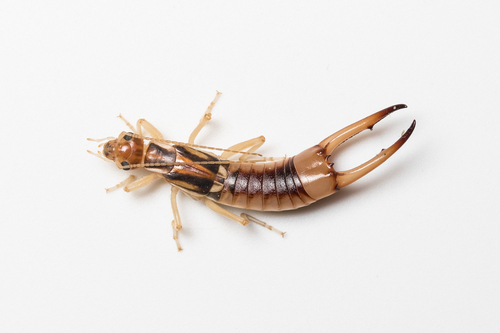
About Labidura riparia (Pallas, 1773)
Labidura riparia (Pallas, 1773) is a species of earwig in the family Labiduridae, distinguished by forceps-like modified cerci and a light tan body color. It is commonly known by multiple common names: the shore earwig, tawny earwig, riparian earwig, or the striped earwig, named for the two dark longitudinal stripes that run the full length of its pronotum. It is sometimes mistakenly called Labidura japonica; this name actually refers to a subspecies, Labidura riparia japonica, which is distributed from Japan and India to Papua New Guinea. L. riparia is a cosmopolitan species, found mainly across tropical to subtropical regions. Body size varies widely, ranging from 16 mm to 30 mm, and individuals have 10 abdominal segments. Males and females differ in the size and shape of their forceps: males have much larger forceps with a much stronger curve, while females have smaller, straighter forceps with only a slight curve at the tip. Earwigs use these forceps to assist with predation, defense, sexual selection, courtship and mating, and wing folding. L. riparia is a subsocial earwig with complex maternal behaviors. It is a voracious predator and widely regarded as an effective agent for pest control in many contexts. Repugnatory glands in these earwigs produce a foul-smelling secretion that acts as a pheromone to deter predators, and this secretion is described as smelling like decomposition. Males of this species have two interchangeable penises, though individual males have a preferred penis that they use most often. Just like human limb dexterity, 90% of L. riparia males are "right-handed" when it comes to penis use. This unequal distribution is unique to this species among all other earwigs, and it may be related to the location of the spermatheca in females. The striped earwig prefers dark, moist environments with shelter to hide in during the day. It can occupy a wide range of habitats, including both cultivated and uncultured farmlands, woodlands, and the margins of ponds and lakes. To conserve energy, these earwigs use abandoned mole cricket burrows as brooding nests. Individuals will fly after a disturbance to find a new nest if their original nest has become waterlogged or destroyed. They have been observed flying toward light, because they orient themselves using the moon. L. riparia is a generalist predator whose diet consists entirely of insects or scavenged animal matter. It prefers Lepidoptera larvae and insect eggs, but will eat any available insect. The earwig can use its long, powerful cerci to kill and immobilize larger insects. Thanks to its flexible diet, it can easily adapt to any habitat as long as insects are present. When a ready food supply is not available, it has been recorded eating nymphs and eggs of its own species. As a nocturnal insect, this earwig only hunts after sunset, and feeds most actively just after sunset. Female feeding habits are shaped more by their ovulatory cycle: females will go long periods without eating to prepare for egg laying. The primary predator of L. riparia is ants, which prey on unattended earwig eggs. There is reciprocal predation between the two groups, as L. riparia also preys on ant eggs, but the impact of ants on earwig populations is much stronger than the reverse effect: earwig populations increase when ant populations decrease. Nests are critical for protecting earwigs and their offspring from environmental threats and predators, and are required for offspring survival. Specialized nests are dug for molting, feeding, and egg laying. The female selects a suitable site and digs a nest under a rock or tree bark. Female earwigs act as the primary caregivers for offspring, and become hostile to males when they are in brooding chambers. As a female lays her eggs, she grabs each egg individually and cleans it to remove fungi or dirt immediately after it is laid. She does this for 60 to 100 eggs total, and after finishing laying she rests on top of the eggs, similar to a hen. The female continues to groom the eggs and guard them for 10 days until the eggs begin to hatch. Once the eggs hatch, the mother leaves to search for food for her young, and continues to feed and groom the nymphs until they leave the nest 2 to 5 days later. Each female will go through this reproductive and care process up to three times over her life, and sometimes cares for more than one clutch at a time. Some females get lost when returning to their brood, and will start caring for another female’s clutch, because they cannot distinguish their own young from unrelated offspring. After leaving the nest, young earwigs dig their own molting nests, and take anywhere from 4 to 50 days to reach the next instar. They repeat this process through a total of 6 instars before reaching adulthood. Once they become adults, individuals only live for 2 to 3 months, and begin courting immediately after reaching maturity. Courtship involves touching with antennae, and mutual grasping of each other's abdomens with forceps, until copulation occurs. There are 2 to 3 generations per year, and the last generation of the year hibernates underground through the winter.

