About Labia minor (Linnaeus, 1758)
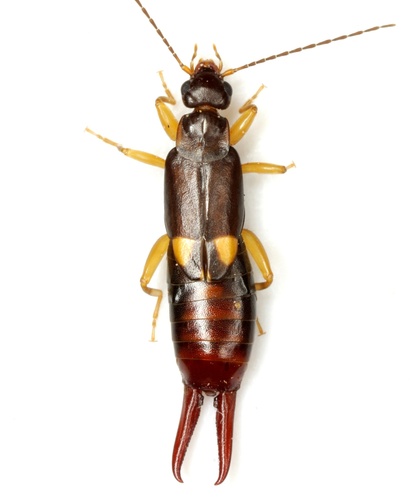
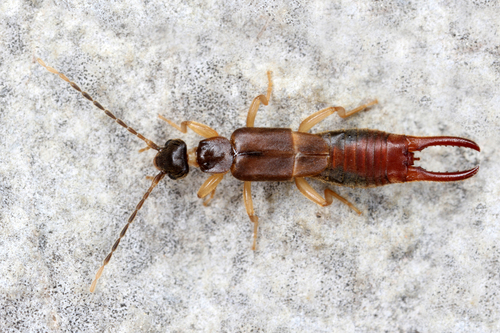
Labia minor (Linnaeus, 1758) is approximately half the size of Forficula auricularia, with a body length of 4 to 7 millimetres (0.2 to 0.3 inches). Its body is chocolate brown, and it is less shiny than the chestnut brown Forficula auricularia. The entire body of Labia minor is covered in fine yellow bristles called setae, and its antennae are a paler shade than the rest of the body. The pincer-like forceps at the end of its tail are used to unfurl its wings before it flies. Unlike Forficula auricularia, Labia minor flies often. Labia minor is widespread across temperate regions worldwide. It is not confirmed whether this species is native to North America, or if it was an early introduced species. The first recorded observation of Labia minor in the United States dates to 1838, but the species may have been present in the region long before that date. It ranges farther north into British Columbia and Quebec than any other earwig species, and it is the only earwig species found in Quebec. It has also been introduced to Australia, Madeira, the Galápagos Islands, and the Philippines. Due to its very small size, Labia minor is probably often overlooked, so it may be more widespread than current records indicate. Labia minor feeds on decaying plant material and other detritus. In cooler climates, it is only found in warm locations, such as actively decaying compost heaps, and is most commonly encountered when compost is turned. Unusually among insects, Labia minor shows extensive maternal care of its eggs and newly hatched offspring; the mother feeds her young for one to two weeks after they hatch.