About Kyphosus vaigiensis (Quoy & Gaimard, 1825)
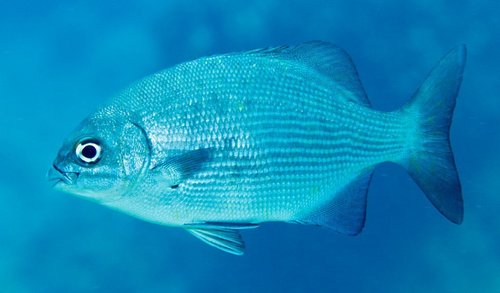
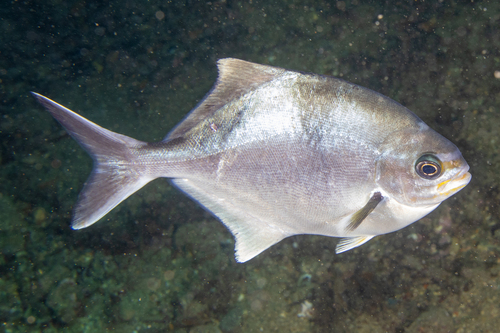
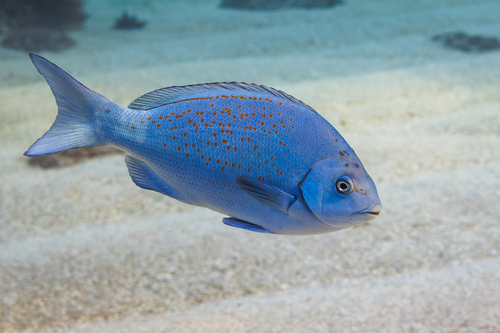
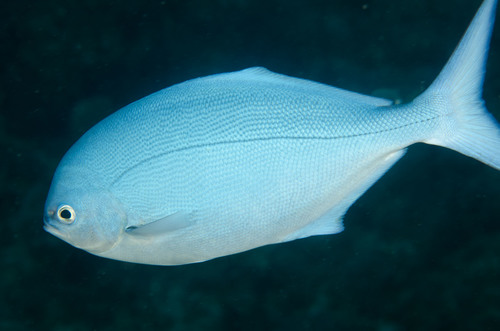
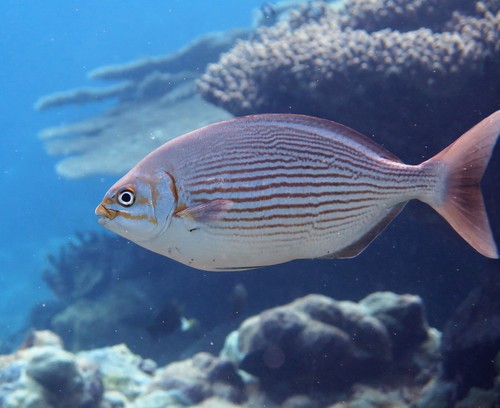
Kyphosus vaigiensis has an elongated, oval-shaped body with a moderately notched caudal fin. It has a small head with a short snout, and a small terminal mouth holding small incisor-shaped teeth; teeth are also present on the roof of the mouth and the tongue. Neither the dorsal fin nor the anal fin is tall. The dorsal fin has 10 to 11 spines and 13 to 15 soft rays, and can fold into a sheath. The anal fin has 3 spines and 12 to 14 soft rays. A key identifying feature of this species is the presence of scales in the interorbital region. Its body is silvery with a bluish sheen, marked with 23 to 29 golden horizontal lines running along the body; lines above the lateral line curve parallel to the lateral line. A golden streak runs below the eye, extending from the snout to just past the front edge of the eye. Fins are grey, or slightly darker grey than the body color. The maximum recorded total length of the species is 70 centimetres (28 in), while a more typical total length is around 50 centimetres (20 in).
Kyphosus vaigiensis is distributed across most of the world's warmer seas and oceans. In the Pacific Ocean, it occurs from the western coast of the Americas (from Mexico to Panama) westwards across the Pacific to Hawaii, Easter Island, Polynesia, Tahiti and Micronesia, reaching as far north as Japan and as far south as Australia; there are also records of the species from the Hauraki Gulf in New Zealand. In the Indian Ocean, it is found across the region to the Red Sea, the eastern coast of Africa, and waters off Madagascar. In the eastern Atlantic Ocean, its range includes Ascension Island, St Helena and São Tomé Island. In the western Atlantic, it occurs off the Yucatan Peninsula, the Caribbean, Bermuda, and the islands of Trindade and Martin Vaz. The species has also been recorded in the Mediterranean Sea, with the first record from Spain in 1998, and additional records from Sicily, Cyprus, Israel and Turkey. It is thought that Mediterranean populations originated from Atlantic individuals that entered the sea via the Straits of Gibraltar, but some may have arrived through Lessepsian migration via the Suez Canal, since the species is also present in the Red Sea. The species may be establishing a permanent breeding population in the Mediterranean.
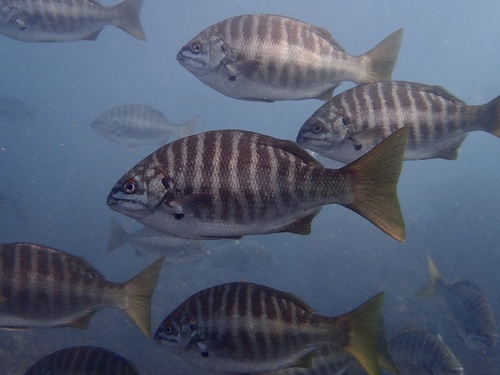
Adults of Kyphosus vaigiensis congregate over hard, algae-covered substrates on exposed, surf-swept outer reef flats, in lagoons, and on seaward reefs. The species occurs to a maximum depth of 24 metres (79 ft). It is found in exposed areas around rocky reefs, with adults typically remaining close to the shoreline. Juveniles are found among flotsam, and may occur in the open ocean near the surface. Juveniles feed on small crustaceans. Adults are carnivorous during summer and autumn, but feed on Petalonia binghamiae during winter. Kyphosus vaigiensis tends to be solitary at higher latitudes, and more social in the tropics, where it forms mixed schools with K. bigibbus, K. cinerascens and K. sectatrix.