About Kyphosus sydneyanus (Günther, 1886)
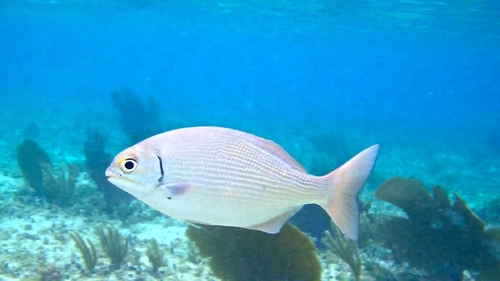
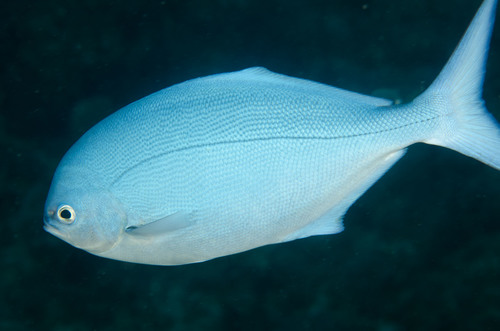
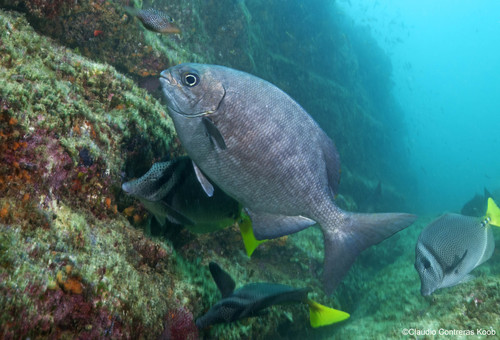
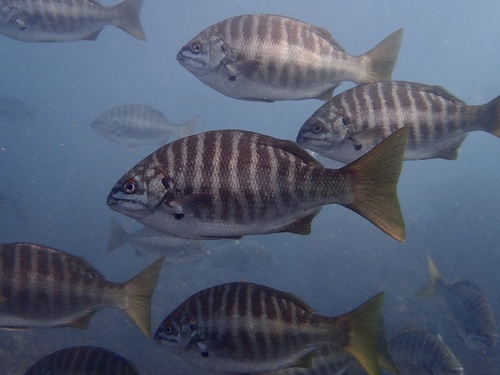
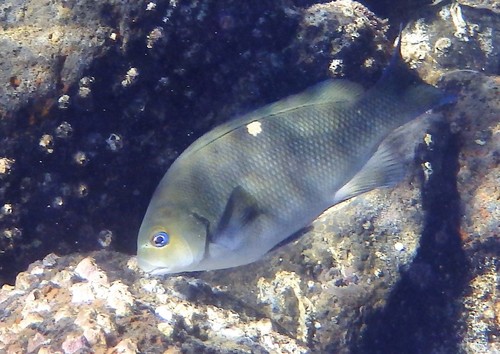
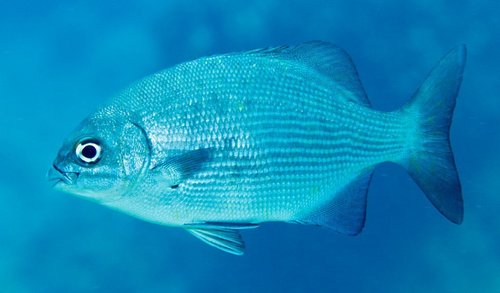
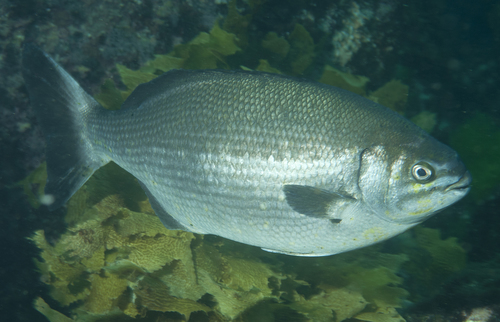
Kyphosus sydneyanus, commonly called the silver drummer, has an oval to circular body shape when viewed from the side; the body is not compressed. The dorsal profile of the head slopes between the interorbital area and the snout, giving this species a characteristic bulging head profile. It has a single continuous dorsal fin, with a spiny anterior section and a soft-rayed posterior section. The spiny section is normally at least one and a half times as long as the soft-rayed section. The dorsal fin contains 10 to 11 spines and 11 to 12 soft rays, while the anal fin contains 2 to 3 spines and 10 to 12 soft rays. The lateral line holds a total of 52 to 66 scales, 42 to 56 of which are pored. This species has a short caudal peduncle and a slightly emarginate caudal fin with slightly rounded lobes. The silver drummer is a large species that reaches a maximum total length of 80 centimetres (31 in) and a maximum weight of 1.1 kilograms (2.4 lb). Its base body colour can be olive, silvery-grey, or bronzy, and it is usually darker on the upper body and paler on the lower body. The caudal fin has a broad dark margin, a reddish-brown bar runs from the upper jaw over the operculum, there is a pale bar beneath the eye, and a small black spot sits on the ventral margin of the pectoral fin base. The silver drummer was first formally described as Pimelepterus sydneyanus in 1886 by British-German ichthyologist and herpetologist Albert Günther (1830-1914), with the type locality recorded as Port Jackson, New South Wales. This species is found in the south-eastern Indian Ocean and the south-western Pacific Ocean, off the coasts of Australia and New Zealand. In Australia, it occurs across the southern part of the continent, ranging from Shark Bay in Western Australia, south along the southern coast, east to Tasmania, and north to Fraser Island in Queensland. It also occurs in the Tasman Sea around Lord Howe Island and Norfolk Island. In New Zealand, it has been recorded as far south as Jackson Bay on the west coast of the South Island, but it is only commonly found around the North Island. Most records of this species from Tasman Sea islands are thought to be misidentifications of Kyphosus bigibbus. Silver drummers are occasionally found as solitary individuals, but they normally gather in large schools. These schools may be mixed with other Kyphosus species depending on location: in Western Australia, mixed schools often include K. gladius and K. bigibbus, while in eastern Australia and northern New Zealand, mixed schools typically only include K. bigibbus. The diet of the silver drummer is mainly made up of phaeophytes (brown algae), most commonly Ecklonia radiata, and rhodophytes (red algae). K. sydneyanus has a highly vascularized hinged gut chamber that is separated by a sphincter. Most microbial fermentation of the fish's food takes place in this chamber, and this fermentation allows the silver drummer to properly digest phaeophytes.