About Kyphosus sectatrix (Linnaeus, 1758)
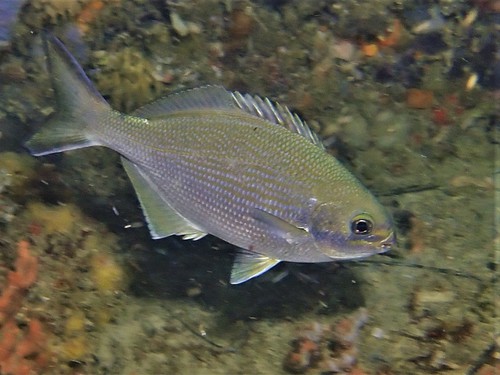
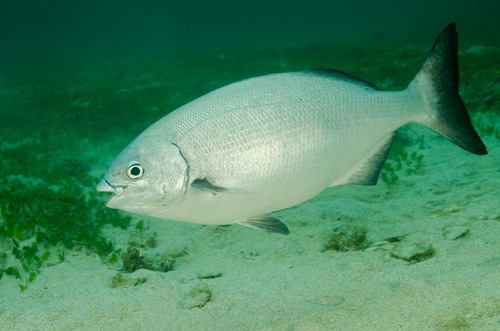
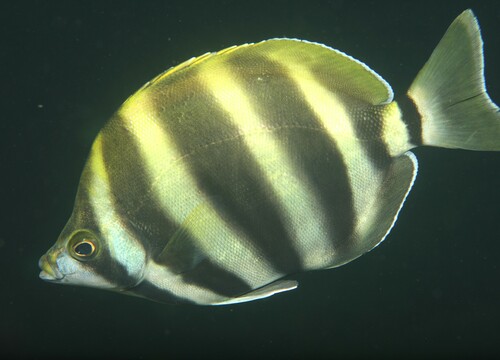
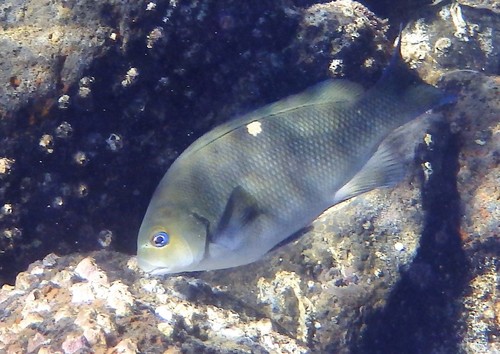
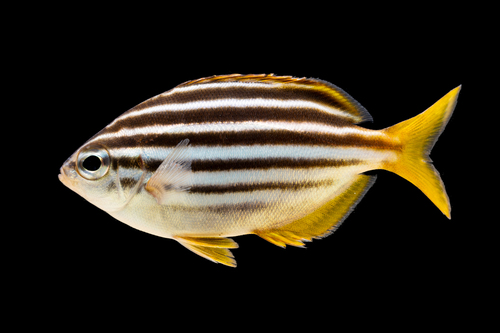
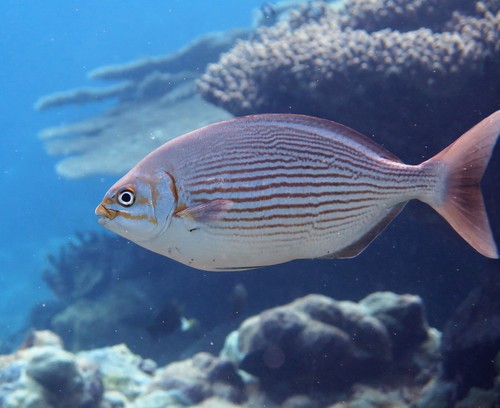
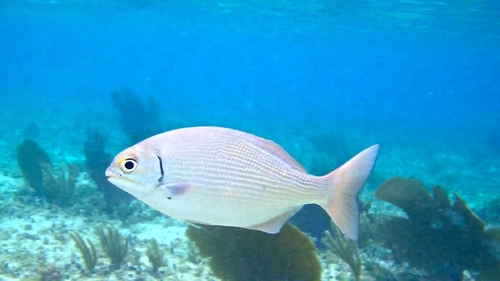
Kyphosus sectatrix, also known as Kyphosus sectatrix (Linnaeus, 1758), has an elliptical body that appears almost circular when viewed from the side. Its head slopes from above the eye down to the snout, giving the fish a beaked or snouted appearance. It has no obvious bulge on the forehead, and a small, horizontal mouth that opens at the front. The jaws hold a regular row of closely spaced, J-shaped incisor-like teeth with rounded tips. The bases of these teeth are positioned horizontally, forming a structure like a bony plate with radial striations inside the mouth. Most of the body, excluding the snout, is covered in ctenoid scales. The dorsal fin is continuous, with its origin located quite far back near the rear of the head, and it is longer than the anal fin. The dorsal fin contains 11 spines and 11–12 soft rays, while the anal fin has 3 spines and 11 soft rays. The caudal fin is emarginate, but not deeply emarginate. The lateral line has 63–81 scales, 50–62 of which bear pores. This species can reach a maximum total length of 76 centimetres (30 in), though a total length of around 50 centimetres (20 in) is more common. The maximum recorded weight for this species is 6 kilograms (13 lb). The body colouration of Kyphosus sectatrix is variable. Typically, it is greenish to bronze on the dorsal side, fading to pale greyish on the flanks and silvery on the ventral side. Faint gold horizontal lines run along the body, there is often a white or silvery streak on the cheek below the eye, and a narrow pale stripe below the base of the dorsal fin. Bright yellow individuals occasionally occur, and these often have black blotches or patches alongside areas of paler yellow or white. Juveniles are grey, with white or pale spots on their bodies and fins. Kyphosus sectatrix has a circumglobal distribution, and occurs in warmer areas of all the world's oceans. In the eastern Atlantic Ocean, it has been recorded from St Helena, Ascension Island, the Azores, and the Canary Islands; it has also been reported from the Algarve in Portugal, and there are records of it from the Mediterranean. In the western Atlantic, it is found off Bermuda, in the Sargasso Sea, the Gulf of Mexico, and the Caribbean Sea, and has been recorded from Brazil's Trindade Islands. It is considered likely that the species occurs along the coast of northwest Africa, and as far north as Portugal. In the Indian Ocean, it has been recorded from Réunion and Indonesia, but is likely much more widespread, and probably occurs along the eastern African coast into the Red Sea, and along the southern Asian coast. In the western Pacific, it has been recorded from southern Japan to the Coral Sea, northern New Zealand, the Kermadec Islands, along Australia's eastern coast from Heron Island, Queensland to Ulladulla, New South Wales, and in the Tasman Sea from Norfolk Island and Lord Howe Island. Its range extends across the Pacific through Polynesia to Hawaii, and at least as far east as the Revillagigedo Islands. Kyphosus sectatrix forms schools, which are often mixed with other related species, on shallow reefs; these schools are frequently observed in the surge zone, but the species also occurs above algal reefs, in seagrass beds, over sandy and rocky substrates, and on reef flats. Juveniles commonly shelter among floating rafts of Sargassum, which allows them to disperse across vast distances. This is an omnivorous species that feeds mostly on benthic algae, and also eats small crabs and molluscs. Off the Fernando de Noronha Archipelago in the southeast Atlantic, Kyphosus sectatrix has been observed feeding on the faeces and vomit of spinner dolphins (Stenella spp); this feeding on mammalian waste has been suggested to be a simple behavioural shift, from feeding on plankton to picking out drifting waste particles. When feeding on algae, the species appears to prefer brown algae.