About Kyphosus ocyurus (Jordan & Gilbert, 1882)
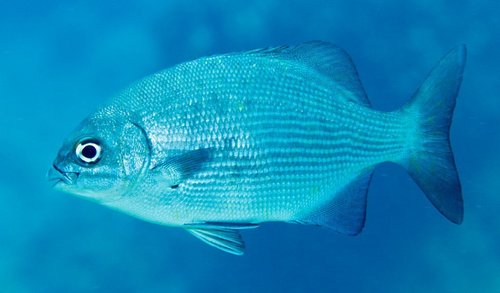
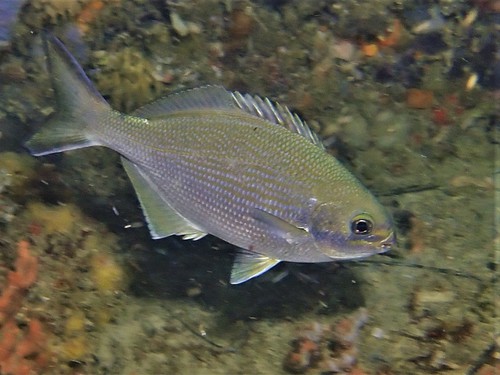
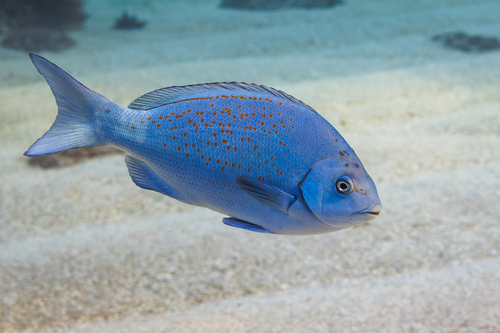
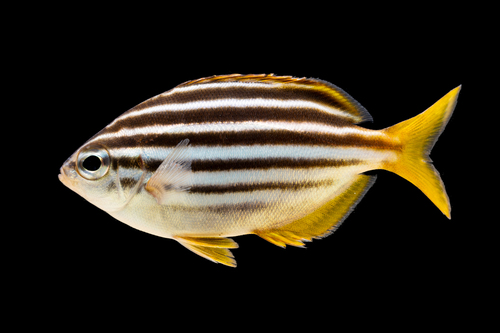
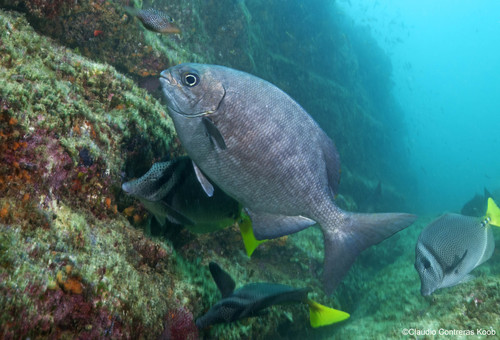
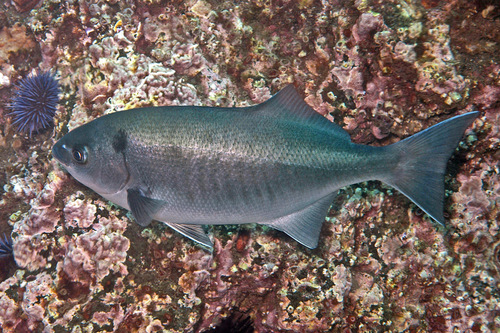
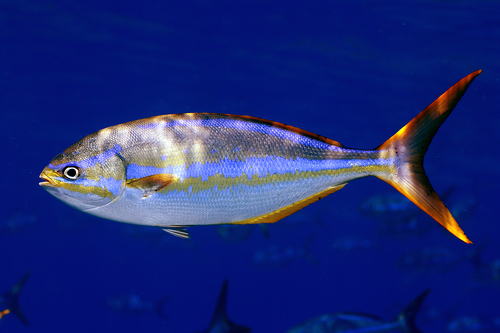
Kyphosus ocyurus (Jordan & Gilbert, 1882) has an elongated, compressed, oval-shaped body. The ventral and dorsal profiles of the head are convex, with a short snout and a very short, horizontal mouth that opens at the front. When the mouth is closed, the upper jaw is partially concealed beneath the orbital bones; the teeth are small, fixed, and incisor-like with flattened tips, and teeth are also present in the middle of the roof of the mouth. It has a continuous dorsal fin: the anterior section holds 11 spines that fold down into a scaled groove, while the posterior section has 13 soft rays. The anal fin is low, with 3 spines and 14 soft rays, and the caudal fin is deeply forked. All of the body, except for the snout, is covered in small, thick, rough scales. This species has distinctive coloration: two wavy horizontal stripes, one yellow and one bluish, run from the mouth to the caudal peduncle. The head ranges from yellow to silvery, marked with a blue streak behind the eye on the gill cover. The back is metallic blue, and the underparts are white. It reaches a maximum total length of 59 centimetres (23 in), with a more common total length of 25 centimetres (9.8 in), and the maximum published weight is 2.0 kilograms (4.4 lb). Kyphosus ocyurus is found in the tropical eastern Pacific Ocean from the Galapagos Islands west to Hawaii, and continues west to the Izu Islands of Japan, including Guam, Palau and the Marquesas Islands. It also occurs off the American coast from southern California to Peru. Kyphosus ocyurus is an uncommon species that occurs as both solitary individuals and in schools, frequently mixing with K. elegans and K. vaigiensis. They live near the surface, at depths no greater than 25 metres (82 ft), along rocky shores, in the open ocean, and in reefs off isolated islands. They have also been observed swimming rapidly in small schools in open water over deep reefs, along sea walls, and at drop-offs. They are also frequently reported near floating logs far out to sea. It is more omnivorous than other species in the genus Kyphosus, and its diet includes zooplankton. K. ocyurus tends not to live in submerged vegetation as an adult, preferring a mix of open water and coral reef environments. Its preferred habitat is a hard ocean bottom with ample visibility. Submerged vegetation is preferred for fish larvae to develop, so most juveniles and young fish live briefly in submerged vegetation before reaching adulthood and moving into more open ocean environments. In terms of movement and migration, K. ocyurus tends to widely disperse from the Indo-Pacific Ocean region into the East-Pacific Ocean region, and eventually into the North Atlantic Ocean region. These fish can cross the Pacific Ocean barrier relatively smoothly, which prevents major external and environmental disturbances from negatively affecting the species' population connectivity. The coelomic organs of K. ocyurus are similar to those of most other members of the family Kyphosidae. The intestinal arrangement of K. ocyurus is complex, with a Z-shaped winding pathway that has an average length of 28 millimeters. This differs from the common single loop seen in many kyphosines, but it is still a more advanced character state when compared to other perciforms. K. ocyurus has three loops tilted to the right in the Z-shaped intestinal pathway, instead of the one loop common in many of its Kyphosidae relatives.