About Kyphosus elegans (Peters, 1869)
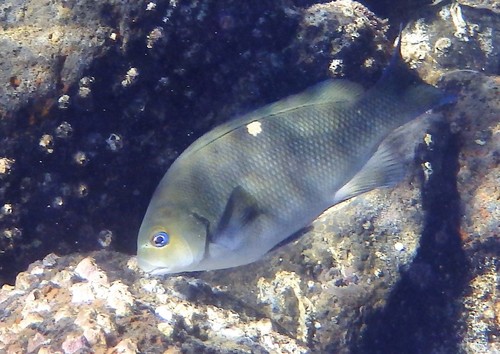
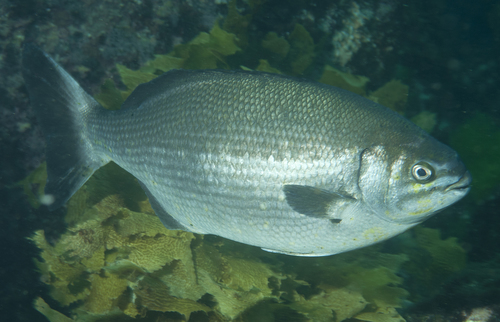
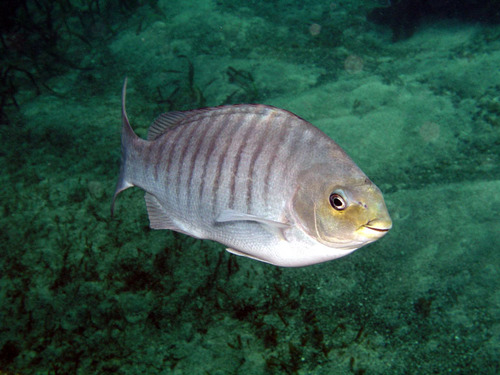
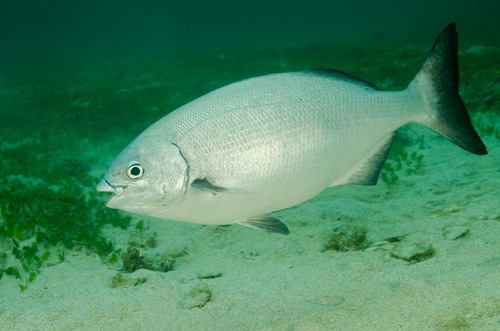
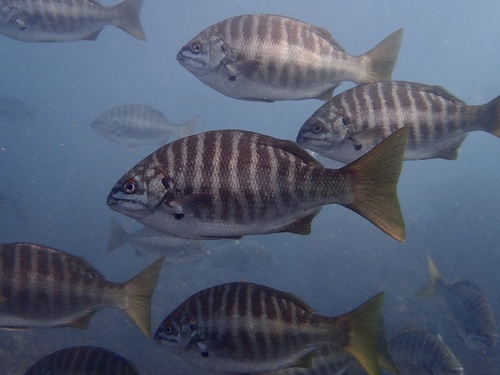
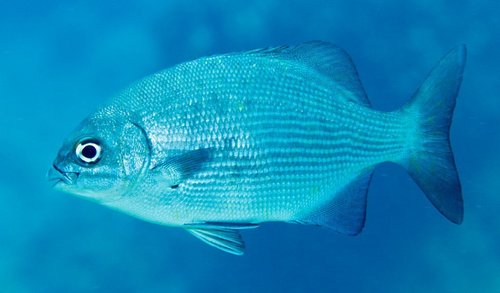
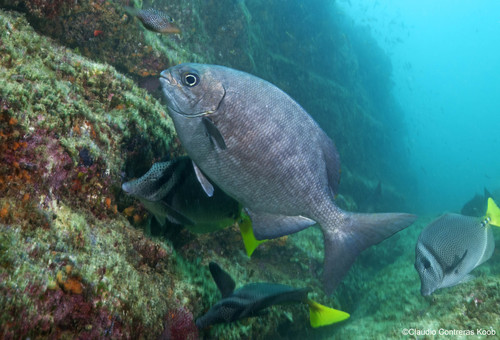
Kyphosus elegans, first described in 1869 by Wilhelm Peters, has an oval, laterally compressed body, a small head and pointed snout, with a steeply sloping forehead in front of the eyes. Its mouth is small; when closed, the maxilla are partially hidden under the preorbital bones. The species has very characteristic teeth that form a single row at the front of both jaws: these teeth are incisiform, lanceolate shaped, resembling the head of a hockey stick, with compressed roots that are set horizontally, creating a striated plate inside the oral cavity, and there are additional teeth on the vomer. The dorsal fin is continuous, with 10 to 11 spines in the front section that can be folded into a scale-covered groove, and 13 soft rays in the rear section, where the first few rays are higher than the rest. The anal fin has 2 to 3 spines and 12 soft rays, with the longest rays located at the front, and these longest rays measure half the length of the anal fin's base. The caudal fin is forked. Most of the body is covered in small, thick, rough scales, with the exception of a patch between the eyes. The lateral line holds 61 to 69 scales, 52 to 57 of which have pores. Body color can be silvery, bronze or brown, and individuals may also have a mottled pattern of white spots across the body. This mottled pattern is more commonly seen in fish showing territorial behaviour. The tail is dusky. This species reaches a maximum total length of 53 centimetres (21 in), while a more common total length is 25 centimetres (9.8 in). Kyphosus elegans was first formally described as Pimelepterus elegans in 1869 by Wilhelm Peters from a type specimen purchased in Mazatlán, Sinaloa, western Mexico. In 1880, Henri Émile Sauvage described a Kyphosus species from Hawaii from specimens sent by the local French consul, naming it Kyphosus sandvicensis. However, there appears to have been a mix-up, as Sauvage's description does not match the type specimen held at the Muséum national d'histoire naturelle in Paris. Recent researchers have found K. sandvicensis is a junior synonym of K. elegans, although Fishbase still treats K. sandvicensis as a valid species with a note that it is a synonym of K. elegans. Kyphosus elegans is distributed in the eastern Pacific Ocean from the Gulf of California to Panama, and also occurs in the Galapagos and other eastern Pacific islands. It is a coastal fish; adults live on reef flats or reefs, while juveniles are often found in tidal pools. It sometimes forms mixed schools with Kyphosus analogus and Prionurus laticlavius, and grazes alongside these species. This species feeds mainly on attached algae, and will occasionally eat plankton and benthic invertebrates. Analysis of the stomach contents of sampled specimens shows that Sargassum is the main alga it eats. It is the host of several ectoparasites, including Caligus chamelensis, C. latigenitalis, C. mutabilis and C. serratus.