About Kyphosus bigibbus Lacepède, 1801
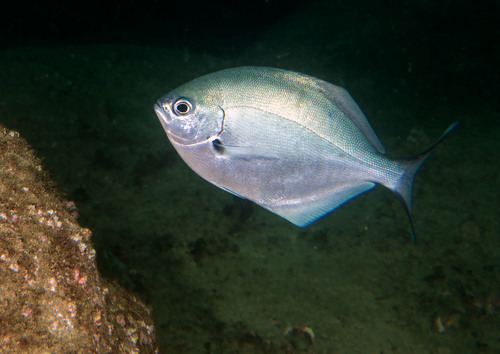
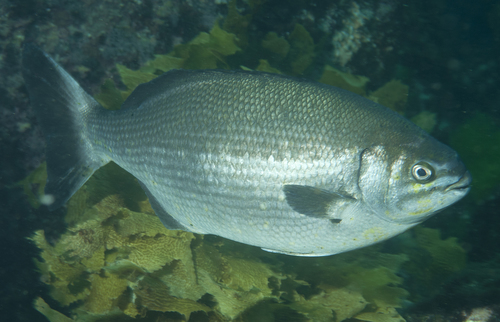
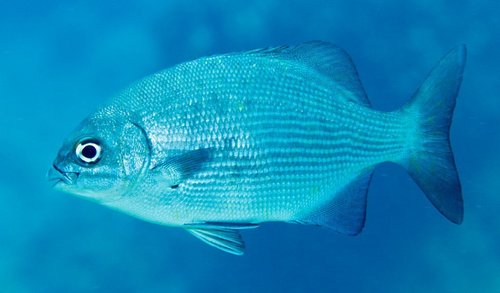
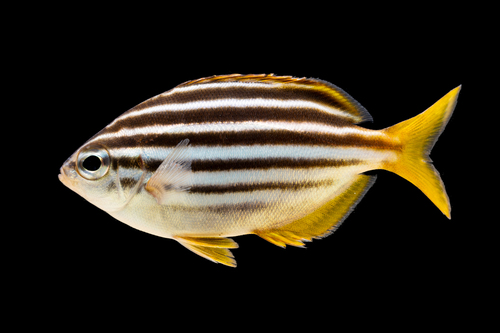
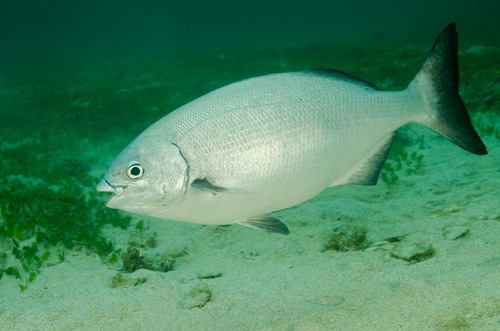
Kyphosus bigibbus, the brown chub described by Bernard Germain de Lacépède in 1801, has an oval, laterally compressed body, paired with a small head, pointed snout, and slightly bulging forehead. Its mouth is small, terminal, and nearly oblique; when closed, the maxilla are hidden beneath the preorbital bones. The teeth are fixed and incisiform, shaped like a curved J with rounded crowns, and their bases lie horizontally within the mouth. Teeth are present on the center of the mouth’s roof and on the tongue. The dorsal fin maintains a consistent height along its entire length. The anterior portion of the dorsal fin holds 11 spines that fold down into a scaled furrow, while the posterior portion has 10 to 12 soft rays. The anal fin has three spines and 10 to 12 moderately long soft rays, with a fairly long base. The symmetrical caudal fin is forked, but not deeply forked. The lateral line contains 61 to 76 scales, of which 51 to 60 are pored. Body coloration ranges from uniform grey to brownish, with a silvery underside and a bronze to greenish tint on the dorsal side. The body has very faint dark stripes, and whitish streaks typically appear on the cheek. The dorsal and anal fins are often dark, with black margins along their soft-rayed sections. A dark patch may sometimes be visible on the lower posterior angle of the pectoral fin base, and the caudal fin is usually dark. Completely yellow individuals are rarely recorded, and albinos are extremely rare. The maximum recorded total length for this species is 75 centimetres (30 in), and the maximum recorded weight is 1.9 kilograms (4.2 lb).
Kyphosus bigibbus was first formally described by Bernard Germain de Lacépède in 1801, in volume 3 of Histoire naturelle des poissons. Lacépède did not specify a type locality, but later sources list it as Fort Dauphin, Madagascar.
This species has a wide distribution across the Indian, Pacific, and Atlantic Oceans. In the Indo-Pacific, it has been recorded off Western Australia as far south as Rottnest Island; in eastern Australia, it ranges from southern Queensland and New South Wales south to Montague Island. It also occurs off northeastern New Zealand, and in the Coral Sea near New Caledonia, Lord Howe Island, Norfolk Island, and the Kermadec Islands. In the Indian Ocean, it is thought to range widely along the northern coasts from Myanmar to Yemen. In the western Indian Ocean, it occurs as far north as the Red Sea, and from the Gulf of Aden off Somalia south to Madagascar and Réunion. Its range extends around the Cape of Good Hope, but its presence in the Persian Gulf has not been confirmed. In the western Pacific, it is found off southern Japan, Korea, and China as far south as Taiwan, but it does not occur in equatorial areas. In the western Atlantic, it has been observed off Bermuda, Grand Cayman Island, Belize, and San Blas, Panama. In the eastern Atlantic, it has been recorded from Saint Helena, Madeira, and Ascension Island, and is thought to occur around the Gulf of Guinea Islands and along the west African coast to South Africa. It also occurs along the Atlantic coast of northwestern Africa as far north as Portugal, but has not been recorded from the Mediterranean. It has also been recorded from Brazil.
Kyphosus bigibbus inhabits shallow coral and rocky reefs, including exposed isolated offshore reefs and reefs around islands. It is frequently found in the surge zone, and occurs down to depths of 20 metres (66 ft). It often forms mixed schools with other related species. Juveniles frequently hide among flotsam, and can disperse long distances while drifting with this floating material. It is a herbivore that feeds mainly on algae from the genera Sargassum and Turbinaria.