About Kyphosus azureus (Jenkins & Evermann, 1889)
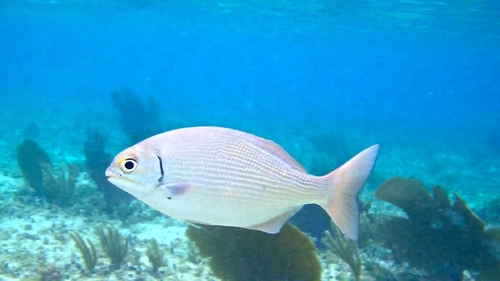
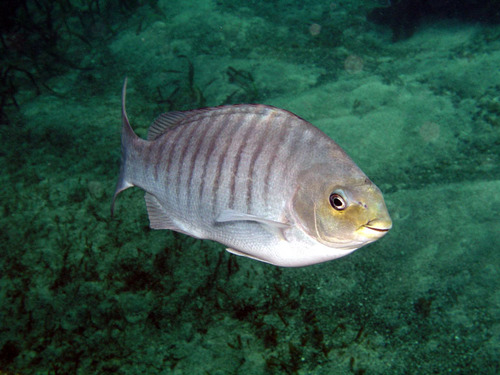
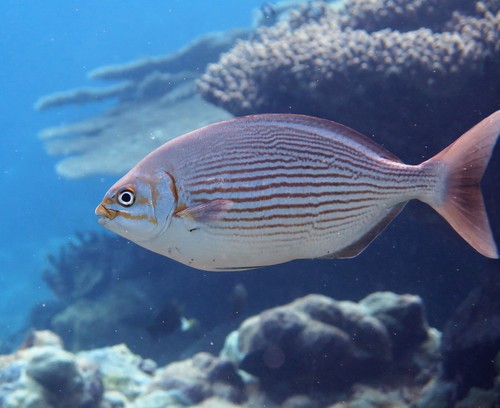
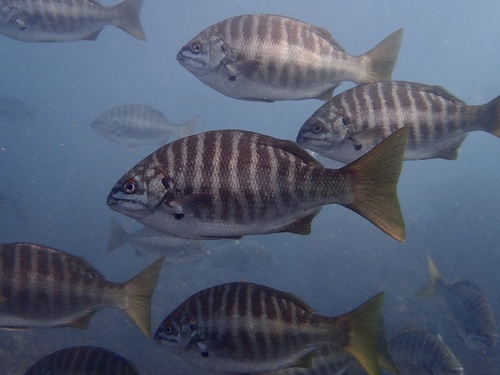
Kyphosus azureus has a moderately deep, compressed, oval body, with a small head that features a pointed snout and a small mouth with thick lips. It has a continuous dorsal fin that holds 11 spines, which can be folded down into a scaly furrow, and 9 soft rays. The spiny portion of the dorsal fin is longer than the soft-rayed portion. The anal fin has 3 spines and 10 soft rays, which are longer than the soft rays of the dorsal fin. The caudal fin is forked, and both the pelvic and pectoral fins are small. The body, except for the snout and the area between the eyes, is covered in small, rough scales. The body is pale khaki in color, marked by roughly 10 long brown vertical bars. It has a blue spot on the upper margin of the gill cover, a black spot underneath the base of the pectoral fin, and whitish underparts. This species reaches a maximum total length of 45 centimetres (18 in). Kyphosus azureus occurs in the eastern Pacific Ocean, ranging from Monterey Bay in California to Baja California, and extending into the Gulf of California, where it is most common in the northern and central parts of the gulf. It is a shallow water species found in inshore areas down to depths of 8 metres (26 ft), where it inhabits coastal rocky reefs and reef flats with algal growth. Adults live in the subtidal zone, while juveniles live in rock pools. It is a herbivorous species that feeds on red, brown, and green algae. Juveniles act as cleaner fish for opaleye (Girella nigricans) and shiner perch (Cymatogaster aggregata). This species often forms mixed schools with halfmoon (Medianluna californiensis), opaleye, and Pacific sergeant major (Abudefduf troschelii). This diurnal species hides in crevices at night, and it is a pelagic spawner.