About Kurokawia palmulata (Michx.) S.Y.Kondr., Lőkös & Hur
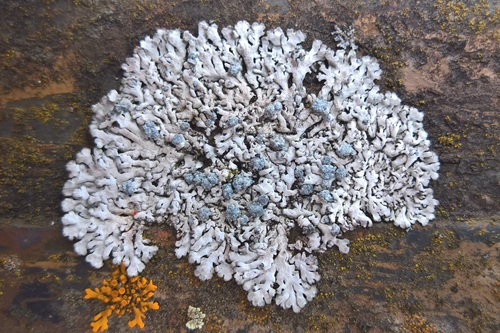
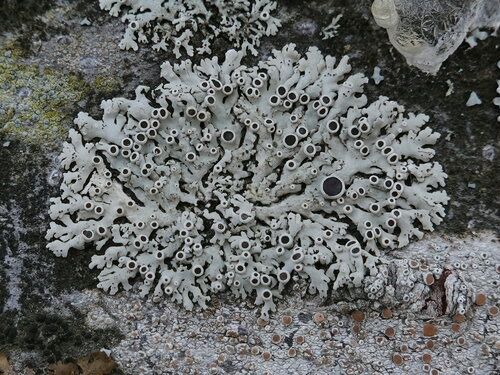
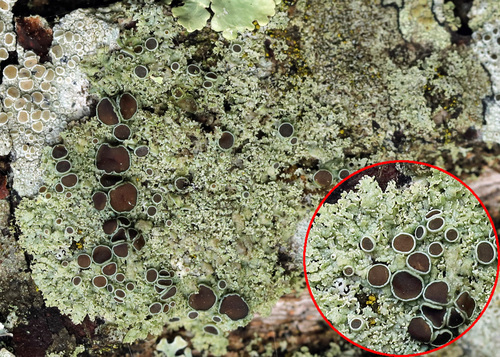
Kurokawia palmulata is identifiable by its foliose thallus, which is typically appressed and can reach 9–10 cm (3+1⁄2–4 inches) in diameter. Its color ranges from brownish-grey to tan-brown. The lobes of Kurokawia palmulata are elongated and linear, branch irregularly, and mostly stay flat at their ends. Unlike many other lichens, this species does not have soredia or isidia, but it often forms lateral secondary lobules. The lower surface of the lichen is initially white or off-white, and darkens gradually to a tawny or light brown color. A distinct characteristic is the superimposed layer of hyphae, which does not bear rhizines. Kurokawia palmulata commonly produces apothecia that are laminal and can grow up to 4 mm in diameter. Chemical spot tests on the upper surface often give a distinctive K+ (yellow) reaction, and variolaric acid has been detected in the species; the strength and prominence of these reactions can vary between individual specimens. Kurokawia palmulata is endemic to eastern North America and eastern Asia, and shows a strong preference for growing on the bark of hardwood trees. It can also grow directly on rock surfaces, or on rocks overlaid with mosses. The species is especially common in regions that make up the eastern deciduous forest. A correlation has been observed between the lichen's geographic distribution and the squarroseness of its rhizines: specimens from the southern part of the range have less squarrose rhizines than those from the northern part. The known North American range of the species was expanded considerably when it was recorded in Ohio, which represents the first report from western North America. Its range extends north to southern Ontario, and to the coniferous old-growth forests of southwestern Nova Scotia, Canada.