About Kurixalus wangi Wu, Huang, Tsai, Li, Jhang & Wu, 2016
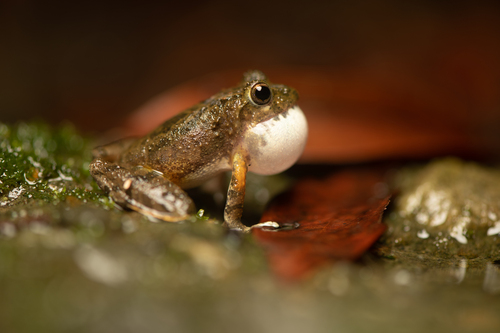
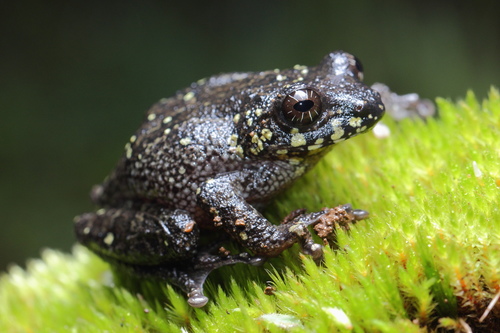
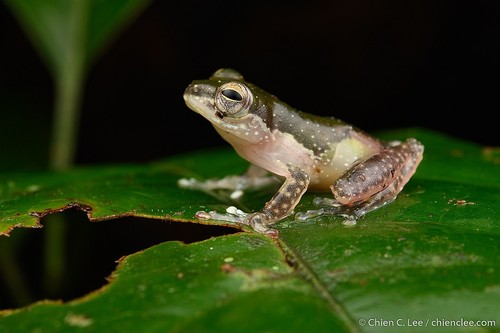
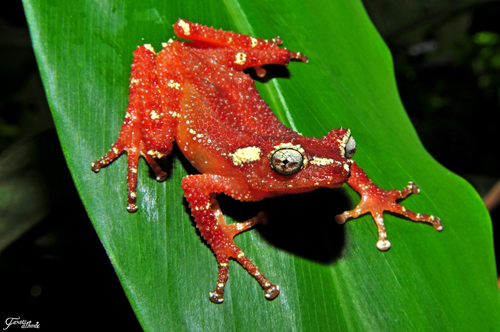
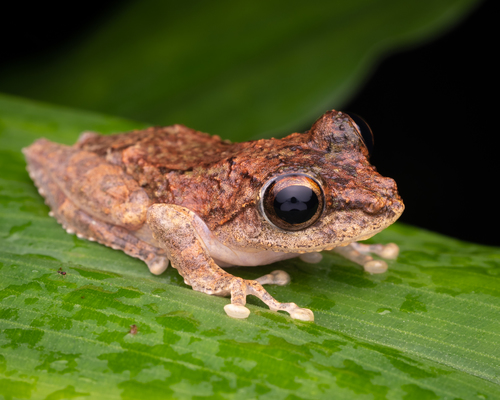
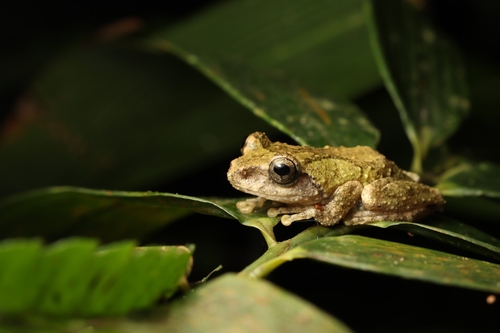
Description: Adult male Kurixalus wangi measure 29–32 mm (1.1–1.3 in) and adult females 31–37 mm (1.2–1.5 in) in snout–vent length. Their overall appearance is slender with a flattened body, and the head is wider than it is long. In dorsal view, the snout is subovoid with a pointed tip; in profile, it is acuminate and slightly protruding. The canthus rostralis is distinct and rounded. The tympanum is distinct, measuring less than half the eye diameter, and its upper margin is covered by the supratympanic fold. The limbs are moderately robust. The tips of the fingers and toes are expanded into discs; fingers have only a trace of webbing, while toes are moderately webbed. Dorsal skin is shagreened, and ventral skin is slightly granular. Dorsal coloration ranges from light brown with distinct dark markings (including a dark X-shaped marking) to almost uniform light green, and the iris is golden-yellow. Distribution: This species is found in Pingtung County, the southernmost county of Taiwan. Habitat and conservation: Kurixalus wangi lives in shrubs of secondary forests and lowland broad-leaved forests at elevations below 500 m (1,600 ft). Its eggs have been found in small pools in tree hollows and man-made structures such as discarded plastic cups and plastic pipes, positioned either above the water or fully submerged. The tadpoles of this species are oophagous. There is limited information available for this species, but it may be somewhat common. No threats to the species are currently confirmed, though habitat loss and degradation, as well as any actions that reduce the number of tree holes, are considered potential threats. However, deforestation rates have declined in Taiwan.