About Kunzea robusta de Lange & Toelken
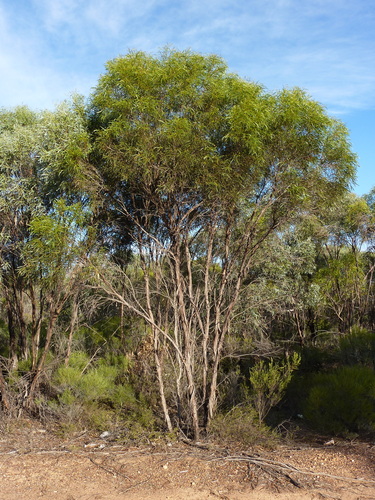
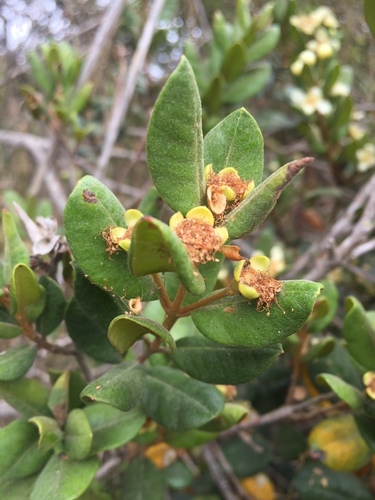
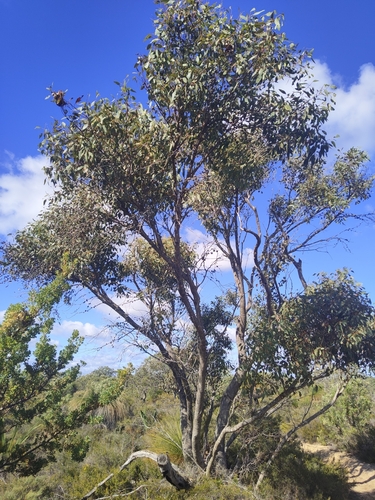
Kunzea robusta de Lange & Toelken, also commonly called rawirinui, is a spreading shrub or tree that typically grows to a height of 20–30 m (70–100 ft). It has rough bark that is stringy or tessellated, and peels upward in long strips. Its leaves are dark green on the upper surface and paler underneath, are lance-shaped, and range from 3.2 to 28 mm (0.1 to 1 in) long and 0.7 to 2.5 mm (0.03 to 0.1 in) wide. Leaves are either stalkless (sessile) or have a short petiole (leaf stalk).
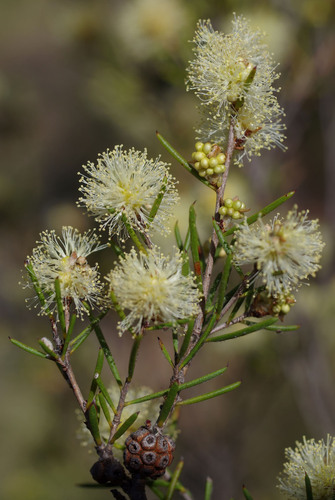
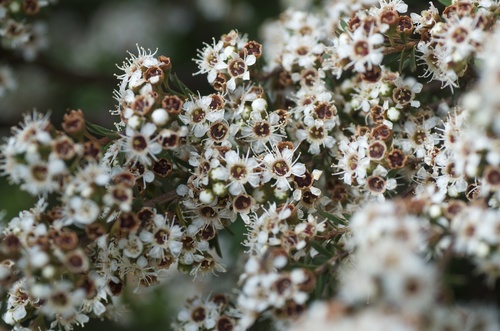
The flowers of this species are white, arranged in compact groups of up to thirty individual flowers, with each flower borne on a 1–5 mm (0.04–0.2 in) long pedicel. The floral cup ranges in shape from conical to top-shaped or cup-shaped, and has five papery sepals that are about 0.5–1 mm (0.02–0.04 in) long and wide. There are five or six petals that range from egg-shaped to almost round, measuring 1.5–4 mm (0.06–0.2 in) long and wide. Between 15 and 60 stamens are arranged in two indistinct rows around the floral cup, with some stamens slightly longer than the petals and others much shorter.
Flowering occurs between April and June, and is followed by a fruit that is a hairy capsule ranging from conical to roughly top-shaped. The capsule is 2.2–4.6 mm (0.09–0.2 in) long and 3.2–5.3 mm (0.1–0.2 in) wide, and typically opens to release its seeds when mature.
Kunzea robusta is widespread and common on both the North and South Islands of New Zealand, and has often been confused with the related species K. ericoides. It grows mostly in coastal and low-lying areas and the nearby hilly country, especially around forest margins, and does not usually grow in upper montane locations.