About Kunzea pulchella (Lindl.) A.S.George
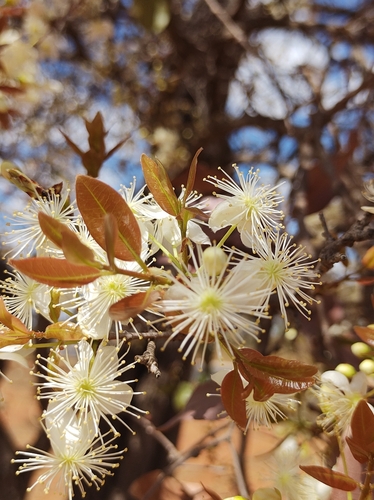
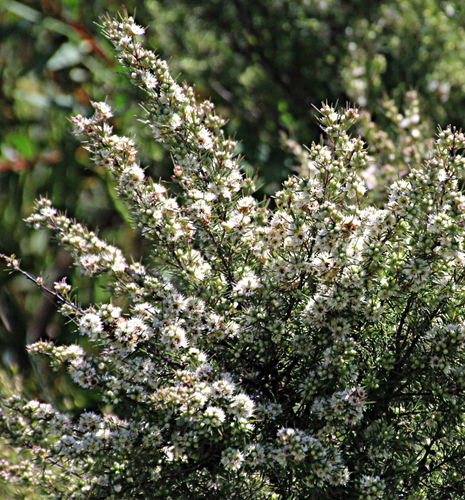
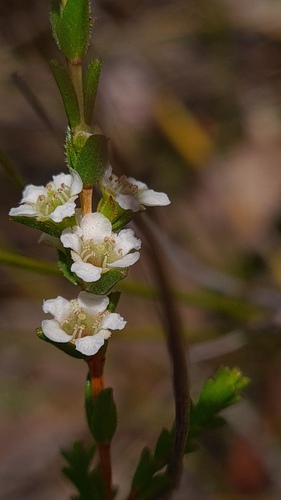
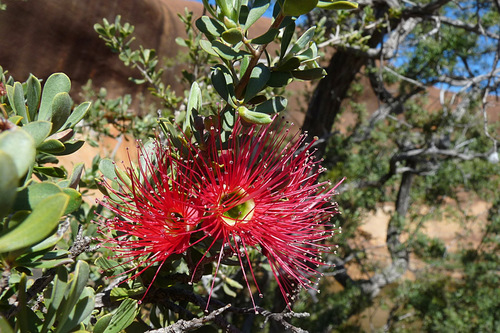
Kunzea pulchella is a spreading shrub that typically grows between 0.6 and 3 meters (2 to 10 feet) tall. It often has few side-branches, and the branches are more or less hairy. Its leaves are arranged alternately, growing on a petiole up to 1 millimeter (0.04 inches) long. The leaf blade is usually 5 to 14 millimeters (0.2 to 0.6 inches) long and 2.5 to 5.5 millimeters (0.1 to 0.2 inches) wide, with a shape ranging from egg-shaped to lance-shaped, with the narrower end at the base. Both sides of the leaves are covered in silky hairs. The flowers are arranged in loose groups of 6 to 14, with each flower growing on a stalk 2.5 to 4.5 millimeters (0.1 to 0.2 inches) long at the ends of branches that often continue growing through the flowering period. Leaf-like, egg-shaped bracts 4.5 to 6 millimeters (0.18 to 0.24 inches) long, plus smaller bracteoles, are present at the base of the flower, and these fall off as the flower develops. The hypanthium is 4 to 5 millimeters (0.16 to 0.20 inches) long, and is densely hairy on the outside. There are five hairy, pointed, triangular sepals 2 to 3.5 millimeters (0.08 to 0.1 inches) long that remain attached to the maturing fruit. The five petals are deep red, almost round, and 3.5 to 5 millimeters (0.1 to 0.2 inches) long. Each flower has more than 70 bright red stamens 10 to 17 millimeters (0.4 to 0.7 inches) long, and the stamens are three to four times as long as the petals. Some forms of this plant produce white to pale cream-coloured flowers. Flowering takes place from June to November, and is followed by fruit that is a broad, urn-shaped capsule 4 to 5 millimeters (0.16 to 0.20 inches) long, with the erect sepals still attached. This species can be distinguished from other Myrtaceae by its red flowers, persistent sepals, and deciduous fruit. Its egg-shaped leaves and triangular sepals separate it from Kunzea baxteri, which also has red flowers. Flower colour is white in the eastern part of the species' range, and pink forms occur in a north-south transition zone that includes Elachbutting, Frog Rock and Duladjin Rock. It has been suggested that the white flower form may encourage pollination by nocturnal moths, supplementing the less reliable visits by honeyeaters in this more arid region. Kunzea pulchella grows in sandy or clay soils, often near or over granite in open scrub. It occurs on granite outcrops in Western Australia, and is among the most common shrubs on these features in the more arid wheatbelt and goldfields areas of the state's southwest region. It prefers growing in narrow fissures in granite, where it anchors itself tenaciously. When growing as the only resident in a small crevice on the face of a granite outcrop, aging plants can take on a bonsai-like appearance. It has a widespread distribution across the Avon Wheatbelt, Coolgardie, Jarrah Forest, Mallee, Murchison and Yalgoo biogeographic regions of Western Australia. In horticulture, this kunzea is best suited to climates with dry summers and wet winters. It can be grown in eastern Australian states if it is propagated from cuttings and grafted onto Kunzea ambigua rootstock.