About Kunzea pomifera F.Muell.
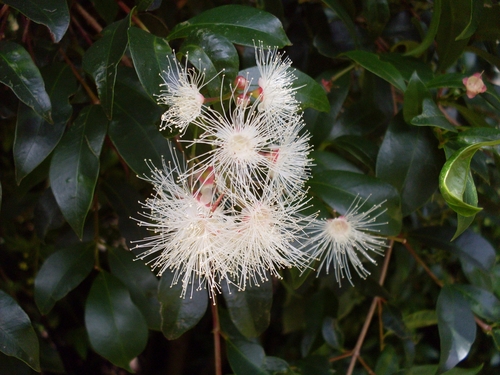
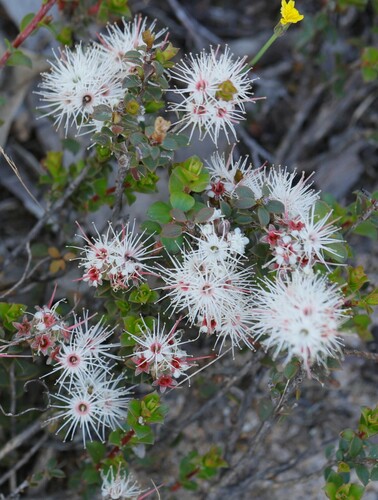
Kunzea pomifera F.Muell. is a low-growing or prostrate shrub that has hairy young stems, and often develops roots along its main branches. Its leaves are arranged alternately, and are egg-shaped to elliptic, or almost round, with a downturned point at the tip. The leaves measure 3–8 mm (0.1–0.3 in) long and 3–6 mm (0.1–0.2 in) wide, and grow on a petiole 0.5–1.5 mm (0.02–0.06 in) long. The flowers are white to cream-coloured, and are arranged in groups that mostly contain between three and eight flowers near the ends of the main branches. At the base of the flowers, there are oblong to more or less round bracts covered with silky hairs that almost reach the top of the floral cup. The sepals are brown, triangular, and 1.5–2 mm (0.06–0.08 in) long. The petals are egg-shaped to almost round, 1–2 mm (0.04–0.08 in) long. The stamens are white and 4–7 mm (0.2–0.3 in) long, while the style is 5–9 mm (0.2–0.4 in) long. The fruit is fleshy, more or less spherical, 8–12 mm (0.3–0.5 in) in diameter, and turns deep red to purple or black when mature. This species, commonly called muntries, grows in Victoria and South Australia. In Victoria, it grows mainly in sandy soil in the Little Desert and Big Desert, with small populations occurring between Portland and Nelson. In South Australia, it grows in sandy soil, often alongside limestone, between the Yorke Peninsula and the Victorian border. The berries produced by Kunzea pomifera are about 1 centimetre (0.39 in) in diameter, green with a tinge of red at maturity, and have a spicy apple flavour. With a crunchy texture, muntries contain up to four times more antioxidants than blueberries and provide natural waxes that are good for skin nourishment. Kunzea pomifera was grown in England in 1889, and was one of the first species of Australian plant introduced into cultivation in England.