About Kummerowia striata (Thunb.) Schindl.
Kummerowia striata (Thunb.) Schindl. reaches up to 16 inches (410 mm) in height. It has alternately arranged leaves that grow up to 0.75 inches (19 mm) long, with entire (untoothed, unlobed) edges. The upper leaf surface is dark green, while the lower surface is light green.
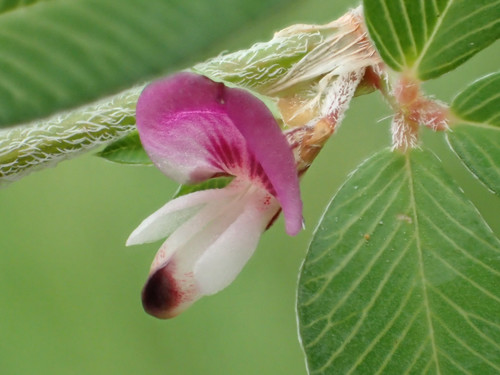
Its flowers, which measure 0.2–0.3 inches (5.1–7.6 mm) long, grow in clusters of 1–3 from leaf axils, and can be pink, purple, or white. The base of the petals and sepals is fused into a cup-like structure. Each flower has five petals and a light green, five-toothed calyx. K. striata is a monoecious species (producing both male and female parts on the same plant) and can reproduce via self-pollination or insect pollination. The species produces two types of flowers: one type with colored petals, and another without petals.
K. striata blooms from August through September, approximately two months from summer into fall. Seeds ripen during the following two months, October through November. Its fruits are 0.2 inches (5.1 mm) long, dry, and remain intact when ripe; each fruit contains a single seed. This plant is an annual species that reseeds prolifically.
Kummerowia striata is native to China and Japan. It is invasive in North America, where it is distributed along the East Coast from New York to Florida, and reaches as far west as New Mexico. It was first recorded in Charleston, Virginia in the 1840s. It is most often found in fields, woods, roadsides, and other areas with disturbed ground, and typically grows in groups rather than as single individuals. It grows best in moist sandy soil with full direct sunlight, but can tolerate other growing conditions. It tolerates a soil pH range of 4.5–7.0, and grows best at pH 6.0–6.5.
In traditional Chinese medicine, Kummerowia striata is used as an anti-inflammatory. It is believed to promote blood circulation, remove heat, and detox blood. Historically, it has been used to treat dysentery, sores, abscesses, and diarrhea, as well as fever, headache, vertigo, and loss of appetite.
Kummerowia striata acts as a food source for many species across the food web, from pollinators to herbivores. Bees are the primary pollinators, and are the only visitors that do not damage the plant. Caterpillars, beetles, and moths eat its leafy foliage during their life stages. Seeds are eaten by the Prairie Deer Mouse, gamebirds, and songbirds. Deer and other large herbivores also feed on the plant's leaves and foliage.
Farmers use Kummerowia striata for livestock grazing. Grazing or cutting is recommended when the plant is in the half-bloom stage, and it is best to leave the bottom three inches of the plant intact. As a legume that blooms from summer to fall, it provides grazing forage when cool-season grazing grasses are not available. It is also edible for humans, with a rating of 2 out of 5 on one edibility scale. Its leaves and seeds are edible when cooked, and its seeds can be ground into meal for baking.