About Kukulcania hibernalis (Hentz, 1842)
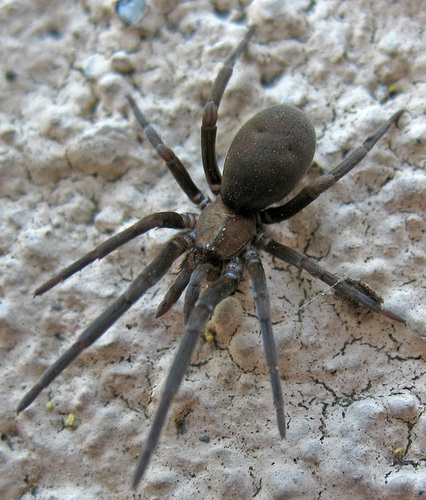
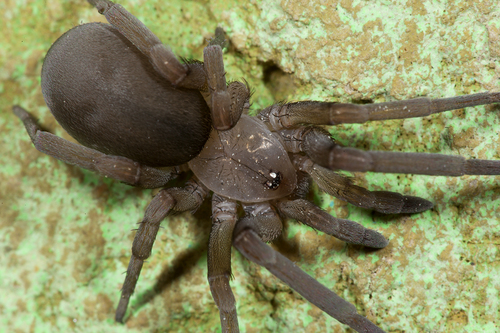
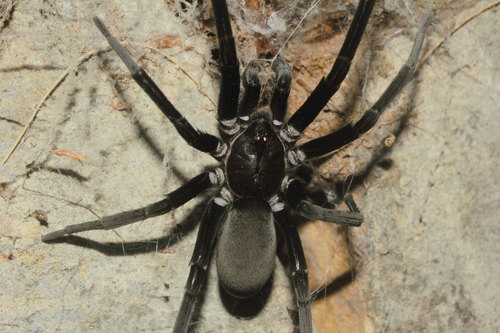
The southern house spider is a species of large spider in the family Filistatidae. Its current scientific name is Kukulcania hibernalis, and it was formerly known as Filistata hibernalis. This species is found across the Americas, ranging from the southern states of the USA, throughout Central America and parts of the Caribbean, down to southern Brazil, Uruguay and Argentina. It displays strong sexual dimorphism. Males are often mistaken for brown recluse spiders, since the two species share similar coloration and body structure. However, male southern house spiders are usually larger than brown recluses, lack the distinctive violin shape on their cephalothorax, and have unusually long slender pedipalps. Females are dark brown or black and have a more compact body build. Both genders can reach roughly 2 inches (5.1 cm) across with legs extended; males typically have longer legs, while females often have larger, bulbous bodies. The abdomen of the southern house spider is covered with fine, velvety light gray hair. Female southern house spiders are rarely seen. They build radial webs around crevices, which is why their family Filistatidae is called crevice weavers. Females rarely move except to capture prey that becomes caught in their webs. By contrast, males typically wander in search of both insect prey and females to mate with, and do not hold any particular territory. The southern house spider is a cribellate spider, meaning its spinnerets do not produce adhesive webbing. To capture prey, the spider uses its legs to comb webbing across its cribellum, a spiked plate located near the spinnerets. This combing action frays and tangles the webbing strands, producing a fine, velcro-like netting that traps insect legs. Male southern house spiders sometimes appear aggressive, but they do not bite unless they are trapped, and their mouthparts are too small to easily penetrate human skin. They do have an unsettling tendency to crawl across anything in their path regardless of whether the object is alive. This behavior is not aggressive; the spiders are almost completely blind and cannot see larger animals. When they feel threatened, these spiders instinctively play dead, a tactic that works well against their common predators. Southern house spiders can crawl through crevices as narrow as 1/4 in (0.66 cm) thanks to their elongated bodies and compact legs. The mating ritual of the southern house spider is a lengthy, elaborate process that lasts over an hour, with long periods where neither the male nor the female moves significantly. When a wandering male encounters a female's web, there may be an initial confrontation where each startles the other. After recovering, the male builds a large web around the female's crevice. Once this web is complete, the male pulls continuously on its strands to draw the female out of her hole, which can take several minutes. After the female emerges, each spider taps the other in an attempt to grasp one another by the forelegs, while the male remains suspended in his web. Female Kukulcania hibernalis produce clutches that hold approximately 129 eggs. Each egg measures about 1.37 mm in diameter and weighs around 1.42 mg. The average body mass of an adult female southern house spider is about 347.0 mg.