About Kuhlia rupestris (Lacepède, 1802)
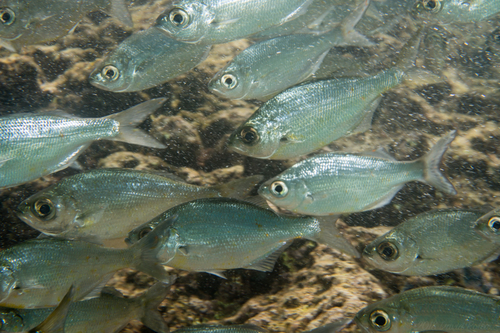
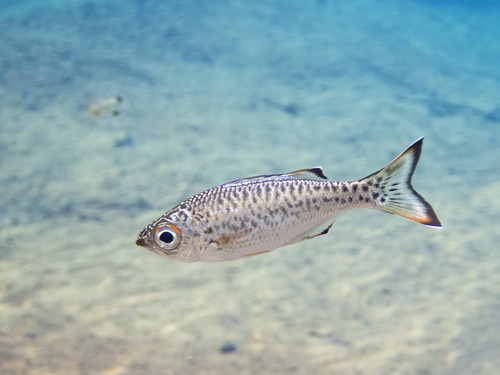
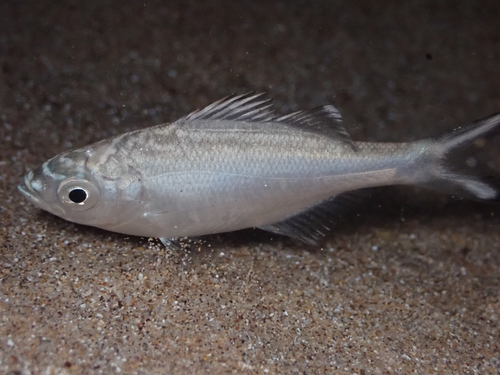
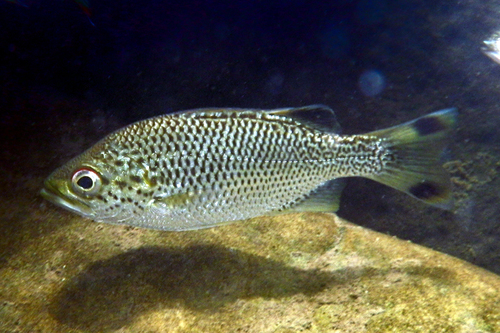
Kuhlia rupestris has a moderately deep, compressed body. It has a pointed head with an oblique, protractible mouth and large eyes. Its dorsal fin is deeply notched, and its caudal fin is emarginate with relatively rounded lobes. This species is brown to olive on its upperparts, silvery on the flanks, and white on the belly and breast. The flanks are marked with numerous dusky or red-brown spots, and each lobe of the caudal fin has a black blotch. The scales are cycloid. In older individuals, the black tail blotches may fuse to form a vertical bar. The dorsal fin has 10 spines and 10 to 12 soft rays, while the anal fin has 3 spines and 9 to 11 soft rays. Kuhlia rupestris has a wide distribution across the Indian and Pacific oceans. It is found off eastern Africa from Somalia south to South Africa, across the Indian Ocean into the western Pacific, north to Japan's Ryukyu Islands and south to Australia. In the Pacific, it ranges as far east as Fiji, Samoa, and the Caroline Islands. In Australia, it occurs from the Gulf of Carpentaria and Cape York south to Tallebudgera Creek in southern Queensland. Kuhlia rupestris inhabits fast-flowing freshwater streams and rivers, normally within rainforest, but also occurs in estuaries and inshore coastal waters, found up to an altitude of 240 metres (790 ft). It is frequently recorded in rocky pools below waterfalls. This species is a migratory fish that must move from freshwaters out to sea to spawn; it is thought to follow flood plumes out to sea in the wet season and spawn in large groups at the margins of these plumes. Sperm produced by male Kuhlia rupestris are not motile in fresh or brackish water, and newly hatched individuals need to migrate to freshwater to complete their life cycle. It is omnivorous, feeding on insects, crustaceans, small fishes, and fallen fruit, especially figs.