About Kuhlia mugil (Forster, 1801)
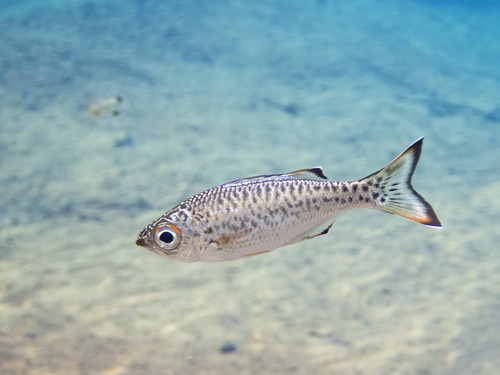
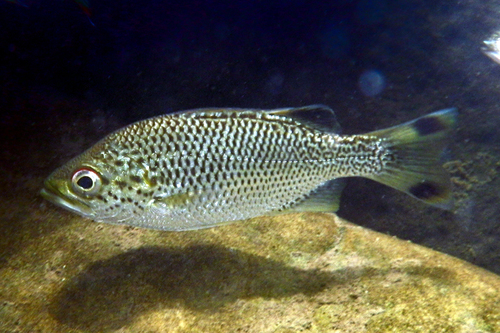
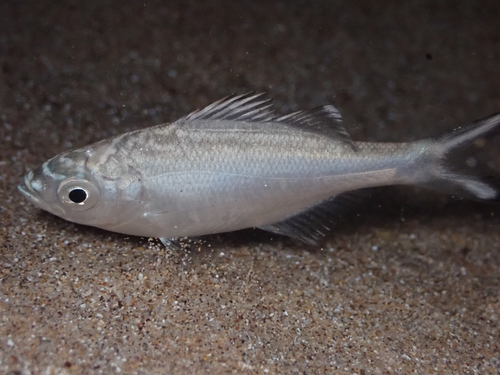
Kuhlia mugil (Forster, 1801) has a compressed, elongated oval-shaped body, with a large eye and an oblique mouth that has a projecting lower jaw. Its body is covered in moderately large ctenoid scales. The species is normally silver in colour; the upper flanks sometimes show a bluish, brownish or yellowish tinge. Its caudal fin has a pattern of five dark bars that alternate with paler areas. A dusky band runs along the margin of the soft-rayed portion of the dorsal fin, except for a white tip on the highest anterior part. The tip of the snout and the tip of the chin are blackish. The dorsal fin is deeply notched. The dorsal fin contains 10 spines and 10–11 soft rays, while the anal fin has 3 spines and 10–12 soft rays. This species can reach a standard length of 40 centimetres (16 in).
Kuhlia mugil has a widespread distribution across the Indian Ocean and the Pacific Ocean. It occurs from the Red Sea and the east African coast, east through the Indo-Pacific to the eastern Pacific islands of Clipperton, Cocos and Revillagigedo. Its range extends north to southern Japan, and south to Australia. In Australia, its range spans from the Torres Strait to Seal Rocks, New South Wales, as well as Lord Howe Island and Norfolk Island in the Tasman Sea, and the Cocos (Keeling) Islands and Christmas Island in the Indian Ocean. In the eastern Pacific, it is found at the tip of Baja California and along the coast from Costa Rica to Colombia. The species is absent from the Marquesas, Hawaii, Easter Island, Pitcairn Island, and Johnston Island.
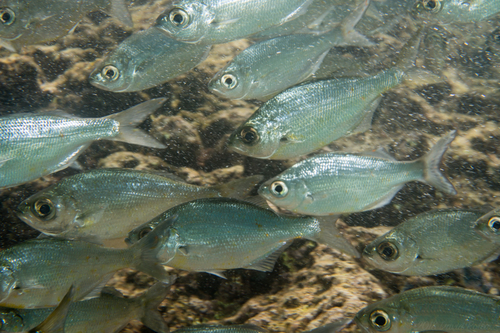
This species lives on reefs at depths of 3 to 18 m (9.8 to 59.1 ft), where it forms tightly packed schools. Young individuals can also be found in tide pools. This species has occasionally been reported from estuaries, but has never been recorded in fresh waters. It is a nocturnal forager, that preys mainly on zooplankton and small fishes.