About Kuhlia marginata (Cuvier, 1829)
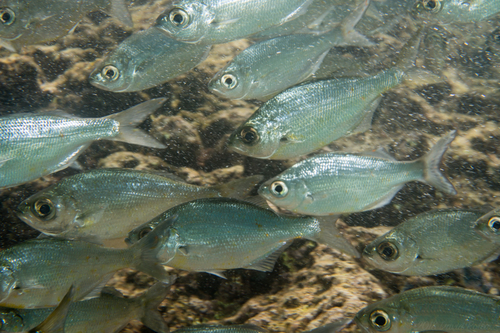
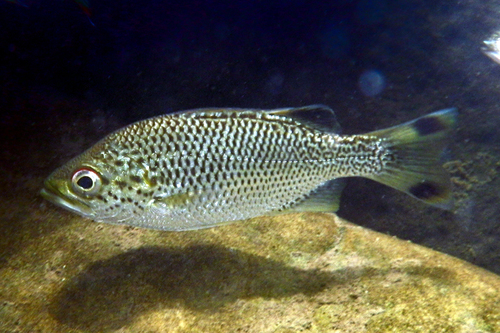
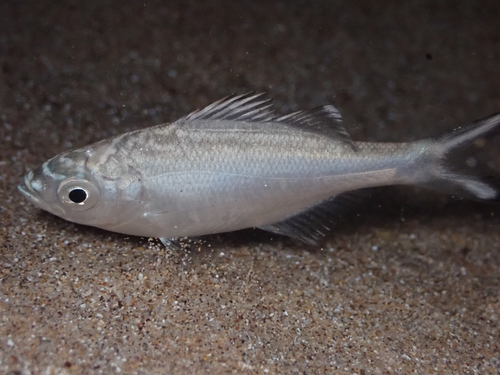
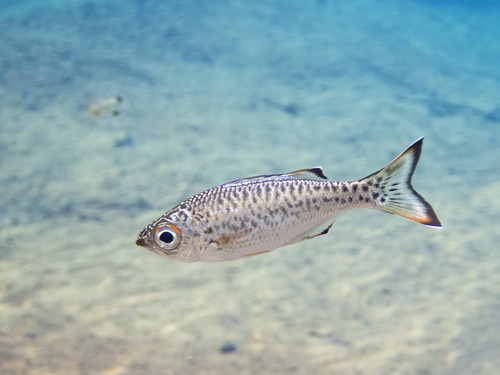
Kuhlia marginata (Cuvier, 1829) has a moderately deep, compressed body, paired with a moderately pointed head. Its large, oblique mouth is protractile, with a projecting lower jaw that extends to just in front of the pupil. The body is generally silvery, and typically marked with dark spots on the posterior, dorsal section of the body. These spots merge toward the head to form a horizontal dusky band, or the dark pigment concentrates along the edges of the scales. Most of the snout and the tip of the chin are blackish. The caudal fin is pale, with a black rear edge that grows wider toward the lobe tips; it also has a very wide pale submarginal area that often holds a chevron-shaped blackish band or a row of dusky spots running parallel to the fin edge. Small blackish spots mark the caudal peduncle. The soft-rayed portions of the dorsal and anal fins have a thin white outer margin, with a broad blackish submarginal zone that thins toward the rear; this zone is wider on the dorsal fin. A distinct patch of red colour is present on the anal fin, and the upper and lower lobes of the tail are pointed. The dorsal fin has 10 spines and 10 to 12 soft rays, while the anal fin has 3 spines and 11 to 12 soft rays. Kuhlia marginata is a widespread Indo-Pacific species that occurs from Japan in the north to Australia in the south, and extends east into the central Pacific as far as the Caroline Islands. In Australia, it is found from Cape Tribulation to the Russell River in Queensland. Adult Kuhlia marginata spend most of their life in freshwater, in flowing rivers and pools below waterfalls, ranging up to 64 kilometres (40 miles) upstream. They are frequently found in estuarine environments, but only rarely occur in the sea. Spawning occurs in the sea, and larvae and juveniles remain in the sea before migrating up rivers to mature. They cannot pass waterfalls, so they tend to live in the lower and mid-catchments of river systems, where they prefer steep, fast-flowing streams. Juveniles leave the sea for freshwater when they reach around 20 millimetres (0.79 in) in standard length. Females mature at a standard length of 95.5 millimetres (3.76 in), and males mature at 83.5 millimetres (3.29 in), after which both migrate back to the sea to spawn. Chemical analysis of sample otoliths suggests that many males do not return to freshwater after breeding, but females may return to the sea to spawn multiple times over their lives.