About Krigia virginica (L.) Willd.
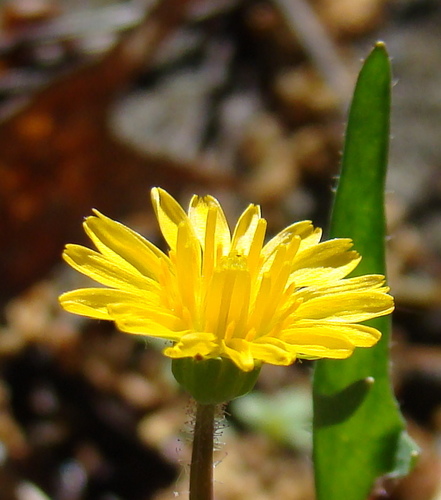
Krigia virginica (L.) Willd. is a spring annual plant that forms a small leaf rosette up to 6 inches across, and produces one or more flowering stalks that reach up to 14 inches tall. Individual plants can bloom even when they are only 2 inches across, an unusually small size. The plant's basal leaves grow up to 3 inches long and ¾ inch across. They are light green, oblanceolate, and often pinnatifid with shallow lobes that have pointed tips. The leaf margins are often ciliate, slightly undulate, and sparsely dentate. Each flowering stalk is unbranched, leafless, and mostly hairless, though a few scattered hairs may grow along its length, especially near the top. Both the basal leaves and flowering stalks contain white latex. Each stalk ends in a flowerhead about ½ inch across. This flowerhead is made up of several spreading ray florets, which are bright golden yellow and truncate with 5 teeth at their tips. The base of each flowerhead holds 9 to 18 lanceolate floral bracts, arranged in a single series and about ¼ inch long. These bracts stay erect while the flowerhead is blooming, and eventually bend backward once achenes mature. The blooming period for a colony of plants runs from mid-spring to mid-summer, and lasts around 2 to 3 months. The small achenes are bullet-shaped: tapered at the base, and truncate at the top. Each achene has 5 small scales and a tuft of 5 hairs at its apex, and the hairs are longer than the scales. Achenes are dispersed by wind. The plant's root system is a tuft of fibrous roots, and it spreads by self-seeding.