About Kretzschmaria deusta (Hoffm.) P.M.D.Martin
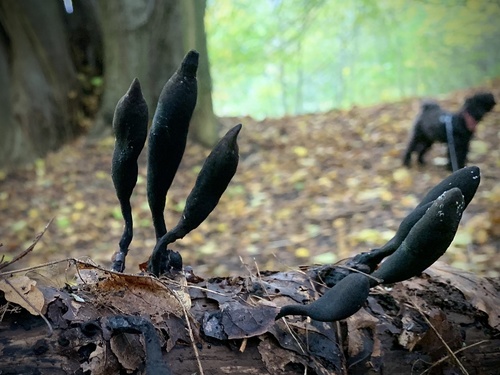
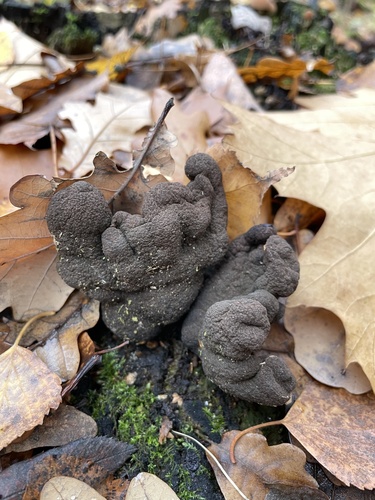
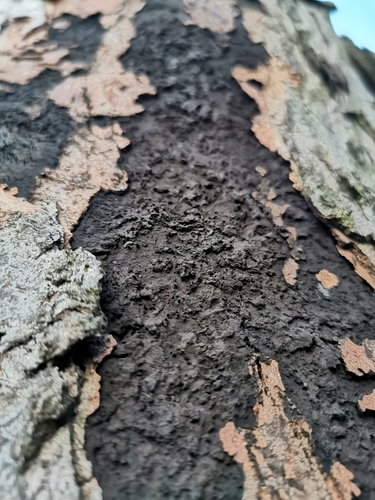
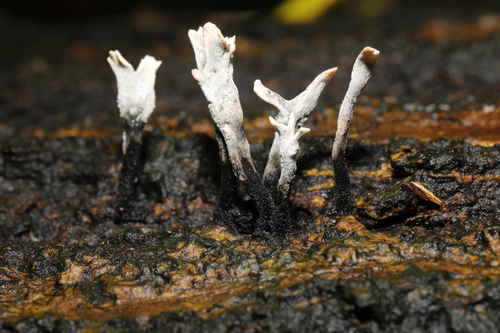
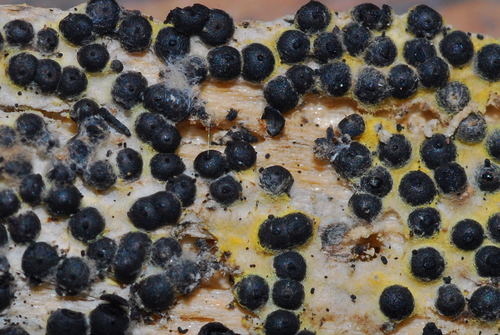
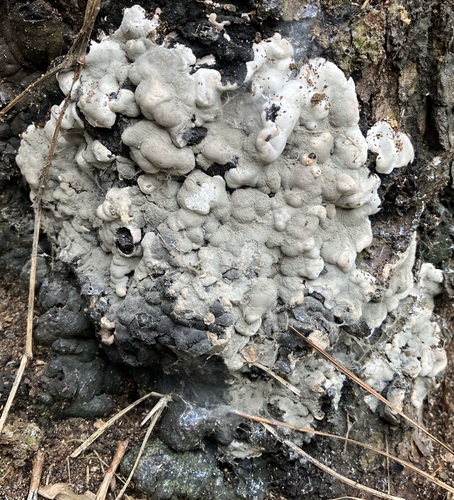
Kretzschmaria deusta forms wavy-edged cushions or crusts. When young, it ranges in color from grey to white, and becomes black and brittle as it ages. Older fruiting bodies look similar to charred wood, which likely causes them to be underreported or overlooked. In its fertile surface layer, this fungus has flask-shaped perithecia that hold asci. Asci typically measure 300 x 15 μm, and each ascus contains 8 spores. Asexual reproduction produces smooth conidiospores, which typically measure 7 x 3 μm. New fruiting bodies develop in the spring; they are flat and gray with white edges. These inconspicuous fruiting bodies persist year-round, and change in appearance to resemble asphalt or charcoal, forming black, domed, lumpy crusts that crumble when pressed with force. The brittle fracture that results can have a ceramic-like fracture surface. Black zone lines are often visible in cross-sections of wood infected with Kretzschmaria deusta. This species is not edible. Kretzschmaria deusta occurs in temperate regions of the Northern Hemisphere growing on broad-leaved trees, and is also found in Argentina, South Africa, and Australia. It grows on living hardwood trees, including but not limited to European beech (Fagus sylvatica), American beech (Fagus grandifolia), sugar maple (Acer saccharum), red maple (Acer rubrum), norway maple (Acer platanoides), oaks (Quercus), hackberry (Celtis), linden (Tilia), and elm (Ulmus), alongside other hardwoods. Its most likely colonization strategy is heart rot invasion. Initial colonization happens through injuries to the lower stems and/or roots of living trees, or through root contact with already infected trees. It causes soft rot, initially and preferentially breaking down cellulose, and ultimately decomposing both cellulose and lignin. The fungus continues decaying wood after the host tree dies, which makes Kretzschmaria deusta a facultative parasite.