About Kosteletzkya pentacarpos (L.) Ledeb.
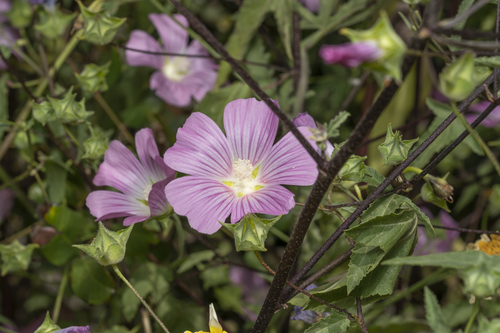
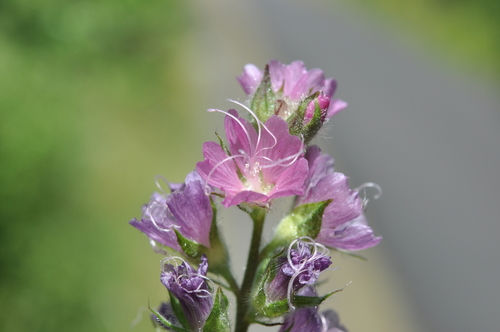
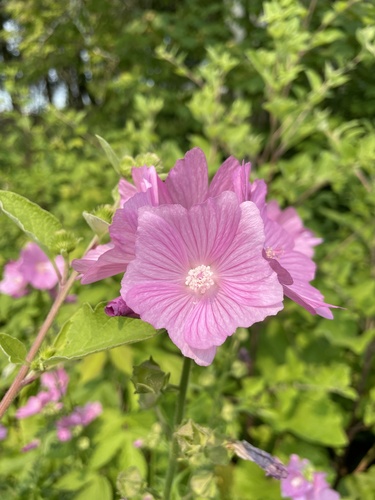
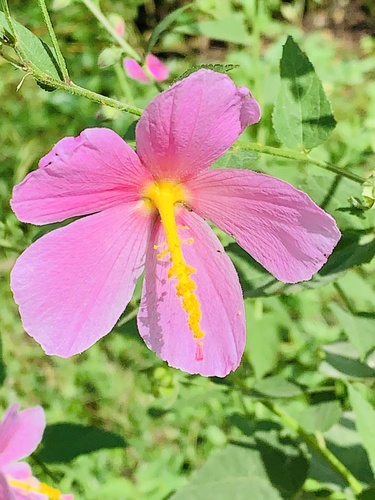
Kosteletzkya pentacarpos, commonly called pink-flowered seashore mallow, is a perennial salt-tolerant halophyte that can grow in areas where most other plants cannot. It reaches over 1 meter in height, with leaves 6 to 14 centimeters long. Its leaves range in shape from cordate to lanceolate, have toothed margins, and both its stems and leaves are covered in hairs. Its flowers measure 5 to 8 centimeters across, with five petals surrounding a tube formed by fused stamens and style. It blooms from July to October, and its flowers range in color from pale to deep pink. This species is occasionally planted in cultivated gardens. In terms of distribution, K. pentacarpos occurs across much of the Atlantic and Gulf coastlines of eastern North America, ranging from New York south to Cuba, east to Bermuda, and west to Texas. It also has a fragmented distribution along the Mediterranean shoreline of southern Europe, including parts of coastal Spain and Italy, the Balearic Islands, and Corsica. Populations of this species found in northern Italy are thought to be introduced. One very small population is known from coastal Georgia, on the shore of the Black Sea. It is also found along the western and southern shorelines of the Caspian Sea in Iran and Azerbaijan. Additionally, K. pentacarpos grows along the Volga and Don Rivers in southwestern Russia, though it is not known if these populations are naturally occurring. For historical and potential modern uses, in ancient Transcaucasia, K. pentacarpos and Hibiscus ponticus were common enough to be harvested in large quantities for their strong stem fibers, which were used to make ropes and nets. Research studies also indicate that K. pentacarpos is a potentially useful species for phytoremediation of saline soils polluted by metalloids, and it can help facilitate the transition of coastal agricultural land to wetlands after sea level rise.