About Koenigia islandica L.
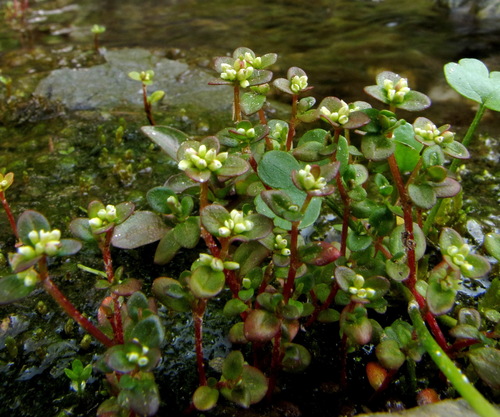
Koenigia islandica L. is a tiny, hairless annual plant with a slender taproot. It grows 1 to 2 cm (0.4 to 0.8 in) tall, and is classed as one of the world’s smallest plants. Its stems are simple or branched, often reddish, and root at their lower nodes. Its leaves grow in opposite pairs, fused at the base to a short sheath that wraps around the stem. Leaf blades are up to 3 mm (0.12 in) long, shaped obovate, oblong or elliptic, and end in a blunt tip. The inflorescence is a few-flowered cyme that has several bracts. Individual flowers are green, white or pinkish, and bisexual. Each flower has three tepals, three stamens, and three fused carpels. The fruit produced is a three-sided nut that holds a single seed. This species flowers during July and August.
Koenigia islandica has a circumboreal arctic/alpine distribution. Its range covers Northern Europe, Central and Northern Asia, North America, Greenland, and Southern Chile and Argentina. It most commonly grows on arctic tundra, wet scree, areas of wet gravel, near lakes, pools and streams, in alpine meadows, and beside patches of melting snow, at altitudes up to 4,000 m (13,000 ft). In the United States, it occurs in Alaska, Colorado, Montana, Utah and Wyoming. In Britain, it is only found in scattered locations on the Isle of Skye and the Isle of Mull.
On the Svalbard archipelago, Koenigia islandica grows on wet alluvial deposits, lake shores, and bare disturbed areas. It grows on the black surface formed by mosses, liverworts and algal crust. It is one of only three annual vascular plant species found on the island, and the only common one of the three. As its range extends into the northern arctic tundra zone, it is recognized as the hardiest annual plant in the world. Its ability to thrive in these harsh environments may stem from its restriction to wet sites, which moderate the local climate: keeping sites warmer during cold weather and cooler during hot dry weather. Even if the plant is killed by heat or drought after it has finished flowering, it can wither and dry out while still producing fruits that contain viable seed. Seeds are dispersed by birds and water, and can remain dormant in the ground for years, only germinating when environmental conditions are suitable.