About Kobus ellipsiprymnus (Ogilby, 1833)
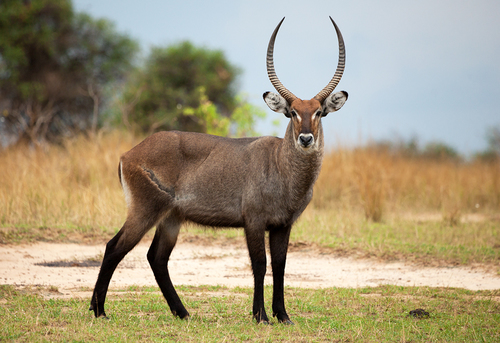
Kobus ellipsiprymnus, commonly called the waterbuck, is the largest of the six Kobus species. It is a sexually dimorphic antelope: males are nearly 7% taller and around 8% longer than females. Typical head-and-body length ranges from 177 to 235 cm (70 to 93 in), while typical shoulder height ranges from 120 to 136 cm (47 to 54 in). Average shoulder height is approximately 127 cm (50 in) for males and 119 cm (47 in) for females. The waterbuck is one of the heaviest antelope species. Newborns typically weigh 13.6 kg (30 lb), and males gain weight faster than females. Adult males typically weigh 198 to 262 kg (437 to 578 lb), while adult females typically weigh 161 to 214 kg (355 to 472 lb). Tails measure 22 to 45 cm (8.7 to 17.7 in) long. The waterbuck has a robust build. Its shaggy coat ranges from reddish brown to grey, and darkens progressively with age; males are darker than females. While the coat is apparently thick, its hair is actually sparse. However, the hair along the neck is long and shaggy. When sexually excited, the waterbuck's skin secretes a greasy, musk-scented sebum substance, which gives the species the alternate name "greasy kob". This secretion has an unpleasant odor that repels predators, and also helps waterproof the body when the animal enters water. Distinctive facial features include a white muzzle, light eyebrows, and lighter-colored inner ears. A cream-colored throat patch called a "bib" is present. The waterbuck has a long neck and short, strong, black legs. Females have two nipples, and preorbital, foot, and inguinal glands are absent. The common waterbuck and defassa waterbuck, two distinct forms of Kobus ellipsiprymnus, differ noticeably in physical appearance: defassa waterbuck have longer tails, while common waterbuck are taller on average. The main difference between the two is the white hair ring surrounding the tail on the rump: it forms a hollow circle in common waterbuck, while the entire area is covered in white hair in defassa waterbuck. Long, spiral horns that curve backward then forward are found only on males, and measure 55 to 99 cm (22 to 39 in) long. Horn length is somewhat related to a bull's age, and a small rudimentary horn in the form of a bone lump may occasionally be found on female skulls.
The waterbuck is native to southern and eastern Africa, including Angola, Botswana, the Democratic Republic of the Congo, Ethiopia, Kenya, Namibia, South Africa, Tanzania, and Uganda, and also occurs in a small number of western and northern African countries including Chad, Côte d'Ivoire, Ghana, Mali, Niger, Nigeria, and Senegal. While it was formerly widespread across sub-Saharan Africa, populations have decreased across most of its current range. Common waterbuck occur east of the Eastern African Rift, with their southern range extending to South Africa's Hluhluwe-Umfolozi Game Reserve in KwaZulu Natal and to central Namibia. In contrast, defassa waterbuck inhabit western and central Africa, occurring west of the Albertine Rift and ranging from Eritrea to Guinea Bissau in the southern Sahel; their northernmost distribution point is in southern Mali. Their range also stretches east of the Congo Basin through Zambia into Angola, with an additional portion extending to the Zaire River west of the Congo Basin. Common waterbuck are now extinct in Ethiopia, while defassa waterbuck are extinct in Gambia. Waterbuck inhabit scrub and savanna areas alongside rivers, lakes, and valleys. Because they require both grasslands and access to water, waterbuck have a sparse distribution across ecotones, the interface areas between two different ecosystems. A study in the Ruwenzori Range found a mean waterbuck density of 5.5 individuals per square mile, while estimates from the Maasai Mara were as low as 1.3 per square mile. Territory size depends on habitat quality, the age and health of the individual animal, and population density: older animals or denser populations have smaller territories. In Queen Elizabeth National Park, female home ranges were 21 to 61 hectares (0.081 to 0.236 sq mi; 52 to 151 acres), while bachelor male home ranges averaged between 24 and 38 hectares (0.093 to 0.147 sq mi; 59 to 94 acres). The oldest observed female, around 18 years old, had the smallest home range.
Waterbuck are largely sedentary by nature, though some may migrate when the monsoon season begins. They are gregarious, and form herds of 6 to 30 individuals, categorized as nursery herds, bachelor herds, and groups of territorial males. Herd size increases in summer, while groups fragment in winter, most likely due to changes in food availability. As soon as young males begin developing horns, at around 7 to 9 months of age, territorial bulls chase them out of the herd. These expelled young males form bachelor herds, and may roam within female home ranges. Females have home ranges spanning 200 to 600 hectares (0.77 to 2.32 sq mi; 490 to 1,480 acres), and a small number of females may form separate spinster herds. While females are seldom aggressive, mild tension can arise within herds. Males begin showing territorial behavior at 5 years old, and are most dominant between 6 and 9 years old. Territorial males hold territories that are 4 to 146 hectares (0.015 to 0.564 sq mi; 9.9 to 360.8 acres) in size. Males tend to stay settled in their territories, though over time they may leave lower-quality territories to occupy more spacious ones. Territorial marking does not involve elaborate rituals, and only occasionally uses dropped dung and urine. After 10 years of age, males lose their territorial behavior and are replaced by younger bulls, after which they retreat to small, unprotected areas. Another social group is satellite males: mature bulls that do not yet hold their own territories, which exploit resources and especially mating opportunities even when the dominant territorial bull is present. A territorial male may allow a small number of satellite males into his territory, and the satellites may help defend the territory. Over time, however, satellite males may displace the original territorial owner and seize the territory for themselves. In a study at Lake Nakuru National Park, only 7% of adult males held territories, and only half of territorial males tolerated one or more satellite males. Territorial males use several types of displays to deter intruders: one display clearly reveals the white throat patch and the white patch between the eyes, while other displays show off the thickness of the neck. Lowering the head and body signals submission to the standing, erect territorial male. Fights can last up to thirty minutes, and include typical bovid threat displays accompanied by snorting. Fights can become so violent that one opponent dies from severe abdominal or thoracic wounds. The waterbuck is generally a silent animal, and uses the flehmen response for visual communication and alarm snorts for vocal communication. Waterbuck often enter water to escape from predators including lions, spotted hyenas, leopards, cheetahs, African wild dogs, and Nile crocodiles; leopards and hyenas target juvenile waterbuck. Despite this behavior, the waterbuck does not particularly enjoy being in water. When alarmed, waterbuck will often run into cover, and males frequently attack predators.
Waterbuck mature slower than many other antelopes. Males become sexually mature at 6 years old, while females reach sexual maturity between 2 and 3 years old. Females can conceive by 2.5 years old, and remain reproductive for ten years after that. In equatorial regions, breeding occurs year-round, with births peaking during the rainy season. In the region south of the Sahara that includes Sudan, breeding is seasonal, with a four-month mating season; in some parts of southern Africa, the mating season is even longer. Oestrus lasts one day or less. Mating begins after the male confirms the female is in oestrus by sniffing her vulva and urine. A resistant female will try to bite or fight off an approaching male. The male performs flehmen, often licks the female's neck, and rubs his face and the base of his horns against her back. Several attempted mounts happen before successful copulation. During copulation, the female shifts her tail to one side, the male clasps her sides with his forelegs and rests on her back, and copulation may occur up to ten times. Gestation lasts seven to eight months, and results in the birth of a single calf; twins are rare. As delivery approaches, pregnant females isolate themselves in thickets. Newborn calves can stand within half an hour of birth. The mother eats the afterbirth, and communicates with her calf through bleating or snorting. Calves remain hidden for periods ranging from two to three weeks up to two months. At around three to four weeks old, the calf begins following its mother, who signals it to do so by raising her tail. Even without horns, mothers will fiercely defend their offspring from predators. Calves are weaned at eight months, after which they join groups of other young waterbuck their own age. Young females stay with their mothers in nursery herds, or may join bachelor herds. The waterbuck has a maximum lifespan of 18 years in the wild and 30 years in captivity.