About Knipolegus aterrimus Kaup, 1853
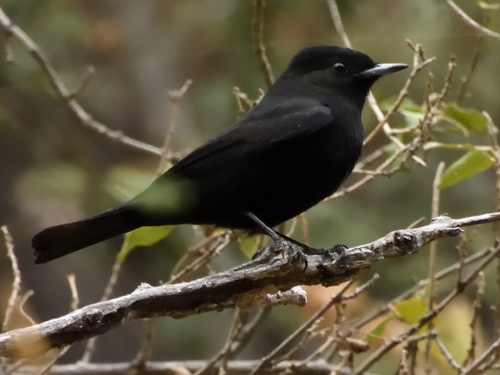
The white-winged black tyrant (Knipolegus aterrimus Kaup, 1853) is 16 to 18 cm (6.3 to 7.1 in) long. For the nominate subspecies, adult males are almost entirely shiny black. Their wings have a wide white band on the inner webs of the primaries and secondaries; this band is very visible in flight but usually hidden when the bird is perched. Adult females have mostly grayish brown head and upperparts, with a slightly darker crown, whitish mottling on the face and lores, and a bright cinnamon-rufous rump. Their wings are grayish brown, with rufous or whitish edges on the remiges and whitish-buff or cinnamon-buff tips on the coverts that form two distinct wing bars. Their tail has a bright cinnamon-rufous base; the rest of the tail is dark brown, with an even darker band across the tip. Their underparts are mostly buffy ochraceous, darkest on the breast and lighter on the throat and belly. Males of the subspecies K. a. anthracinus are duller black than the nominate subspecies. Females of this subspecies have less rufous on their tail than the nominate, and have dusky streaks on the breast. Males of K. a. heterogyna are identical to the nominate subspecies. Females of this subspecies have darker upperparts and paler underparts than the nominate. Their wing markings are much whiter, and their rump, uppertail coverts, and tail are a much paler buffy white. Across all subspecies, both sexes have a dark brown iris and black legs and feet. Males have a blue-gray bill with a black tip, while females have a black bill with a bluish base to the mandible. The white-winged black tyrant has a disjunct distribution. The subspecies K. a. heterogyna is located separately from the other two subspecies, in Peru's Marañón River valley between the departments of Cajamarca and Ancash. The subspecies K. a. anthracinus ranges from Junín Department in central Peru south and east into the La Paz Department of northwestern Bolivia. The nominate subspecies ranges from southern La Paz and Cochabamba departments in Bolivia south through western Paraguay and Argentina as far as Chubut Province. The species has also been recorded as a vagrant in Brazil and Chile. The white-winged black tyrant lives in a variety of somewhat open arid and semi-arid landscapes. These habitats include scrublands, woodlands, the edges of thicker forest, and secondary forest. Overall, it mostly occurs at elevations between 1,500 and 3,000 m (4,900 and 9,800 ft), but can occasionally be found as low as 250 m (800 ft) and as high as 3,800 m (12,500 ft). In Peru, it occurs between 1,800 and 3,600 m (5,900 and 11,800 ft).