About Knautia macedonica Griseb.
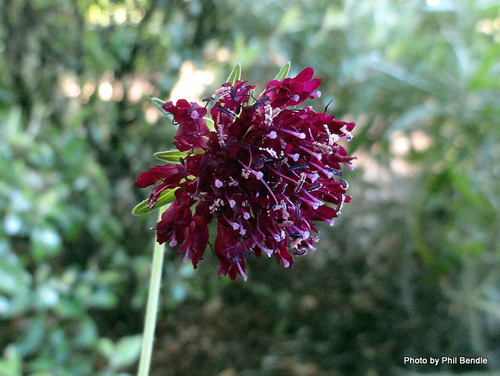
Knautia macedonica Griseb. is a flowering plant distinguished by leaves that are evenly distributed along its stem; basal leaves typically wither by the time the plant blooms. All of its leaves are undivided, and the stem leaves (called cauline leaves) have an ovate, crenate-serrate terminal lobe: this means the tip of the leaf is egg-shaped, with rounded teeth along its edges. One of the most striking features of K. macedonica is its flower heads (called capitula), which measure 1.5 to 3 cm in diameter. Most flowers are a deep, dark red, though lilac and pink variants also occur. This colour variation is often seen within the same population, and may come from natural hybridization with related species such as Knautia arvensis and Knautia ambigua. The chromosome count of this species is 2n=20. Knautia macedonica typically grows in scrubland and open woodland habitats. A biennial variant with broader-based stem leaves, collected from southeastern Romania, has been classified as the separate species Knautia tulceanensis. Knautia macedonica is native to the Balkan Peninsula, where it naturally occurs in scrubland and open forest habitats. Though it is indigenous to southeastern Europe, this ornamental species has expanded its range through human cultivation followed by naturalization. In Slovakia, K. macedonica is a popular garden ornamental. Observations have documented the first confirmed case of its spontaneous spread beyond cultivation on Slovak territory. The species was first spotted in village intravilans (built-up areas), indicating that nearby private gardens were the source of its dispersal. Research on the invasive potential of perennial plantations has shown that this plant can easily spread into surrounding areas. These results confirm that K. macedonica is capable of escaping cultivation and establishing new populations in native habitats. The same pattern of naturalization has been observed in the Czech Republic, where K. macedonica was first recorded as a non-native species in 2018.