About Knautia drymeia Heuff.
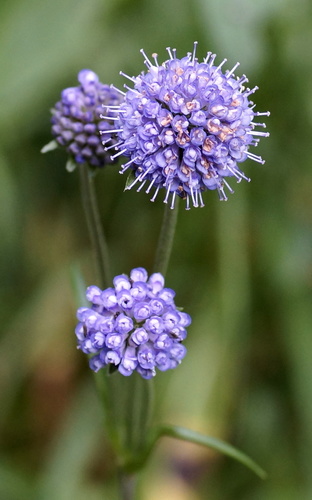
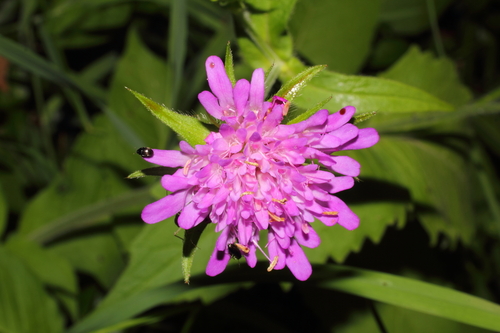
Knautia drymeia Heuff. is an upright-growing perennial widow flower that reaches 40 to 60 centimeters in height. It is easily identifiable by its leaf rosette, which produces multiple flowering stems. The stem of this species is hirsute, and leaves grow along its entire length. The oppositely arranged, simple and entire leaves are usually petiolate, covered with trichomes, and shaped lanceolate to ovate. This species has no stipules. Knautia drymeia is a highly morphologically variable species. Its subspecies can be distinguished by their vegetative features, especially leaf characteristics. For subspecies drymeia, stem leaves are ovate to ovate-lanceolate, and basal leaves bear whitish bristles. Subspecies intermedia can be identified by yellowish bristles on its basal leaves, with stem leaves that are either oblong or lanceolate. Subspecies tergestina has basal leaf bristles of the same colour as those of ssp. drymeia (white to gray), but its stem leaves are round to widely ovate and deeply serrated. The flowers of Knautia drymeia are grouped into calathidium inflorescences, which are surrounded by lanceolate involucral leaves. Each zygomorphic flower has four floral leaves, with petals that are scarlet, scarlet red, or purple; white petals occur rarely. The plant's sepals are reduced to very short, pointed flower bristles, which typically occur in groups of eight. Knautia drymeia has an inferior ovary, with all floral elements positioned above it. This species flowers between June and September, and is pollinated by insects through entomophily. Its hirsute fruit is an achene, and measures 4 to 5 mm in length. Laypeople can easily mistake Knautia drymeia for similar widow flower species, such as the common Knautia arvensis and Knautia dipsacifolia. The chromosome number of Knautia drymeia is 2n = 40; plants are polyploid, and may be either diploid or tetraploid. Knautia drymeia is a European species that favours southern temperate and submeridional floristic zones. Its distribution spans central and southeastern European countries. This relatively common widow flower grows in various shaded forests with dense undergrowth, along forest edges, and in a range of meadows. It only rarely occurs as a component of anthropogenic vegetation. Under the Raunkiær system, Knautia drymeia is classified as a hemicryptophyte.