About Knautia arvensis (L.) Coult.
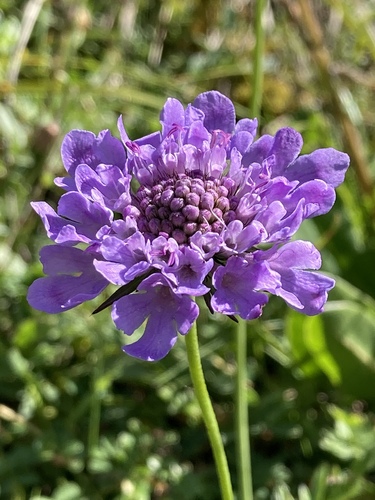
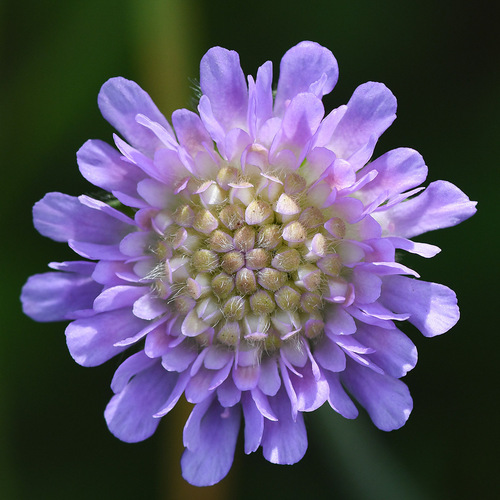
Knautia arvensis (L.) Coult. is a perennial plant that grows 25 to 100 cm (9.8 to 39.4 in) tall. It favors grassy locations and dry soils, and does not grow well in heavy soils. Its flowering period runs from May to August. Flowers are produced in head-shaped inflorescences, each holding many small individual florets. The flower head of this species is flatter than the heads of similar species, including devil's bit scabious (Succisa pratensis) and small scabious (Scabiosa columbaria). Each floret has 4 stamens and one notched, long stigma. The fruit is nut-like, cylindrical, hairy, and measures 5–6 mm (0.20–0.24 in) across. Knautia arvensis has a tap root. Its stem is covered with long, stiff hairs that angle downwards. Its leaves form a basal rosette, and are arranged in opposite pairs along the stem. The lowest leaves are typically spear-shaped and around 300 mm (12 in) long, while upper leaves are smaller. This species has no stipules. Knautia arvensis is commonly found on roadsides, along field margins, and in meadows, and it is especially abundant in areas with chalk bedrock. Ecologically, it is occasionally used as an alternative food plant by marsh fritillary butterflies, whose usual food plant is devil's bit scabious (Succisa pratensis). It is also a known food plant for the narrow-bordered bee hawk-moth (Hemaris tityus).