About Kleinhovia hospita L.
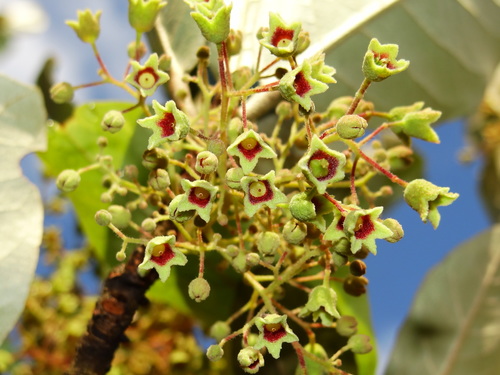
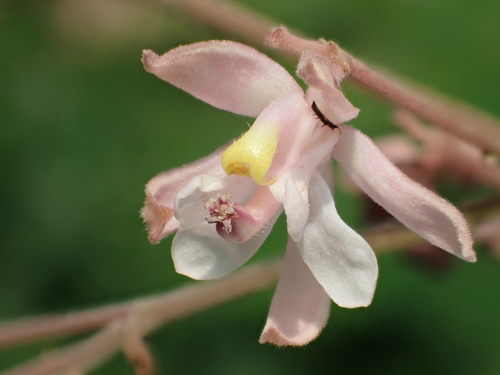
Kleinhovia hospita L. is an evergreen, bushy tree that grows up to 20 m (66 ft) tall, with a dense rounded crown and upright pink sprays of flowers and fruits. Its leaves are simple and alternate. Stipules range from ensiform to linear, and are approximately 8 mm (0.31 in) long. Petioles can grow up to 30 cm (12 in) long. The leaf blade is ovate to heart-shaped, glabrous on both sides, with a pointed apex. It has 6 to 8 pairs of secondary veins, and is palmately nerved. The flowers of K. hospita are terminal, arranged in loose panicles that protrude from the crown. Flowers are about 5 mm (0.20 in) wide, and are pale pink in color. Pedicels grow up to 10 mm (0.39 in) long. Bracteoles are lanceolate, growing up to 4 mm (0.16 in) long, and are pubescent. Gynandrophores are approximately 6 mm (0.24 in) long and pubescent. There are 5 sepals, which are linear lanceolate, about 7 mm (0.28 in) long, pink, and tomentose. There are 5 inconspicuous petals, with the upper petal being yellow. There are 15 monadelphous stamens, growing up to 15 mm (0.59 in) long. The staminal tube is broadly campanulate, adnate to the gynandrophore, and 5-lobed; each lobe holds 3 anthers and alternates with staminodes. The anthers are sessile and extrorse. The pistil has a 5-celled, pilose ovary, one style, and a capitate, 5-lobed stigma. K. hospita flowers year-round, and begins producing fruit early, often in the third year after planting. The fruit of K. hospita are rounded, 5-lobed, thin-walled, membranous capsules 2.5 cm (0.98 in) in diameter, that dehisce loculicidally. Each locule contains 1 to 2 seeds. The seeds are globose, whitish, warty, and exalbuminous. Fruits are more noticeable than flowers due to their large size and abundance. The native range of Kleinhovia hospita includes Bangladesh, Christmas Island, Peninsular Malaysia, Vietnam, Hainan, Taiwan, the Ryukyu Islands, Caroline Islands, Lesser Sunda Islands, Solomon Islands, Vanuatu, Fiji, Tonga, Samoan Islands, and the Society Islands. It has been introduced to the Comoro Islands, Pakistan, Puerto Rico, Sri Lanka, Thailand, Trinidad and Tobago, and the Windward Islands. In parts of Indonesia, Peninsular Malaysia, and Papua New Guinea, Kleinhovia hospita is used as a traditional medicine to treat scabies. Its bark and leaves are used as a hair wash to remove lice, while leaf juice can be used as an eyewash. Young leaves are eaten as a vegetable. Bast fibers from the plant are used to make ropes for tying or tethering livestock. The wood of K. hospita is pinkish buff, moderately fine in texture, soft, light, and easy to season, work, and finish. Its energy value is approximately 19000 kJ/kg. Leaves and bark contain cyanogenic compounds thought to help kill ectoparasites such as lice. Leaf extracts have shown anti-tumour activity against sarcoma in mice. Several fatty acids with a cyclopropenylic ring, along with scopoletin, kaempferol, and quercetin, have been isolated from the leaves. K. hospita is grown as an ornamental plant; the attractive pink panicles have led to its wide spread as an ornamental. The tree bark of K. hospita has good potential as a reinforcement for fiber-reinforced composites due to its high mechanical strength.