About Klais guimeti (Bourcier, 1843)
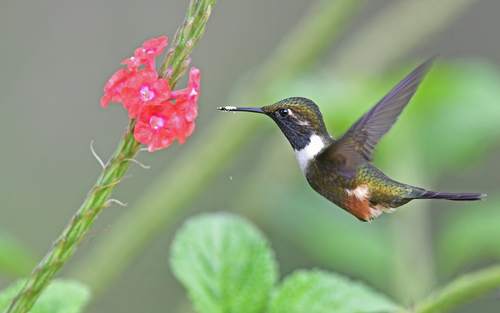
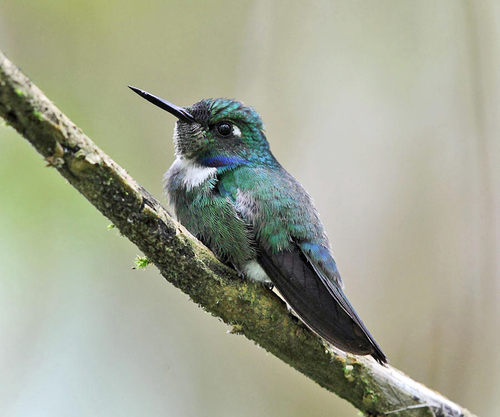
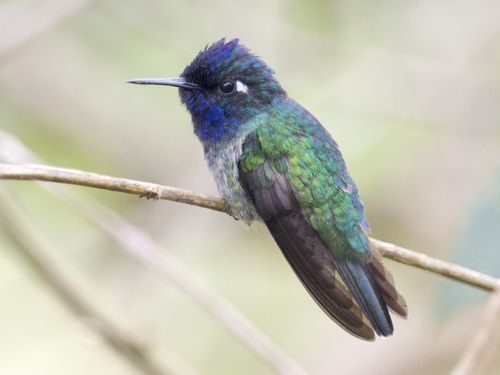
Violet-headed hummingbirds (scientific name Klais guimeti) have an average total length of 8.1 cm (3.2 in), and their short, straight bills average 13 mm (0.51 in) in length. For males, the head and throat are an intense violet or blue color, which shifts with viewing angle, and they have contrasting white spots behind each eye against their dark head. The back is metallic bluish-green or bronze-green, also shifting with viewing angle, the breast is green and fades to a grey belly, the tail is green with tiny white-grey spots, and the wings are black. Females are duller in color, with a blue cap, green back, and grey throat, breast, and belly. Their wings and tail match the male's coloration, and females also have the distinct white spot behind the eye. This species ranges from Central America well into South America, occurring in Honduras, Nicaragua, Costa Rica, and Panama in Central America, and western Venezuela, Colombia, Ecuador, Peru, northern Brazil, and northern Bolivia in South America. The violet-headed hummingbird has a localized distribution: it is common in some areas and rare in other areas that appear to have identical habitat. It occurs in mountain regions, with recorded elevations ranging from 200 to 850 m (660 to 2,790 ft) in Costa Rica, 400 to 1,850 m (1,310 to 6,070 ft) in Colombia, and 150 to 1,900 m (490 to 6,230 ft) in Venezuela. Violet-headed hummingbirds live on the edges of humid primary forest, in openings within secondary forests, in shrubs and thicket clearings, and in various human-modified habitats such as Stachytarpheta hedges in Costa Rica and shade-grown coffee plantations in Venezuela. They feed by drinking nectar from understory flowering shrubs and catching small insects while in flight. In Costa Rica, the species has been reported to favor Stachytarpheta flowers, with as many as one individual every 5–7 m (16–23 ft) along a hedge near Murcia.