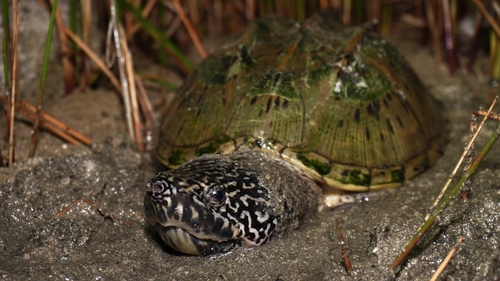
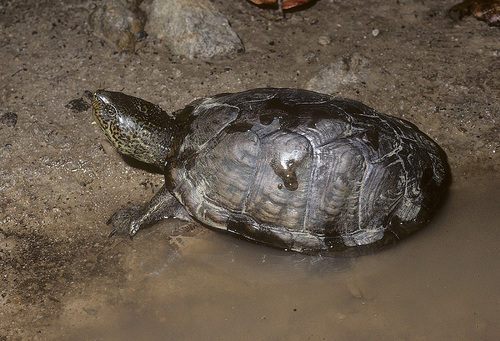
About Kinosternon integrum Le Conte, 1854
The Mexican mud turtle (Kinosternon integrum, first described by Le Conte in 1854) is a species of mud turtle belonging to the family Kinosternidae. This species is endemic to Mexico, where it lives in moist environments including shallow ponds, lakes, rivers, and moderate temperature tropical forest areas. Within Mexico, its distribution covers the states of Aguascalientes, Colima, Durango, Guanajuato, Guerrero, Hidalgo, Jalisco, Michoacán, México, Morelos, Nayarit, Oaxaca, Puebla, Queretaro, San Luis Potosí, Sinaloa, Sonora, Tamaulipas and Zacatecas. The nesting season for Mexican mud turtles runs from early May to September, starting just before the summer rainy season. Most females lay clutches of 2 to 4 eggs, though clutch size can range from 1 to 8 total eggs. This species has a distinct nostril trait that differs between males and females: females have more rounded nostrils that are more brownish in color, while male nostrils are yellow. The Mexican mud turtle uses a bet hedging survival strategy: its organismal fitness changes based on the conditions it experiences. It has low fitness when in a normal, relaxed daily state, and higher fitness when under stress. This bet hedging strategy also impacts its reproduction, restricting breeding to only every two to three seasons.