About Kinosternon flavescens (Agassiz, 1857)
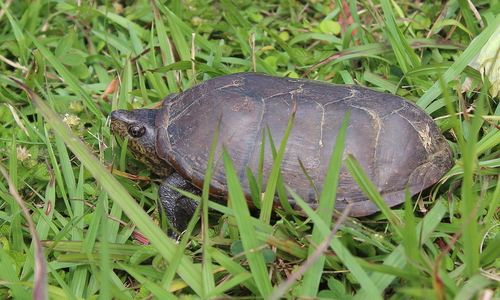
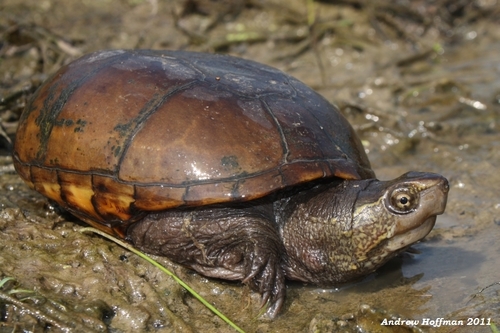
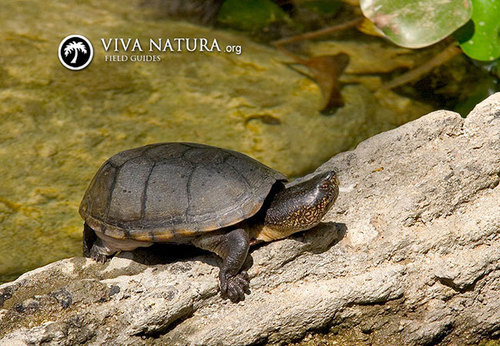
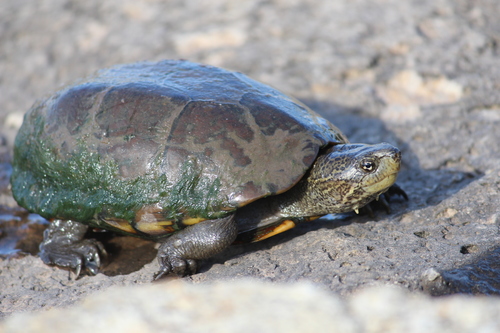
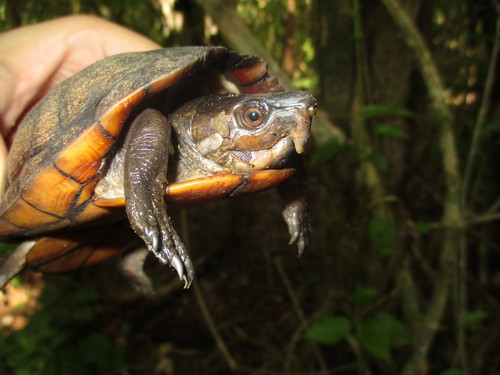
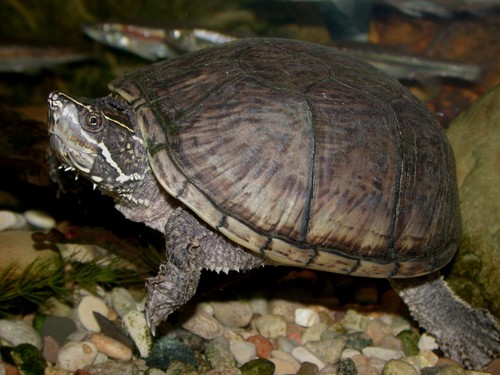
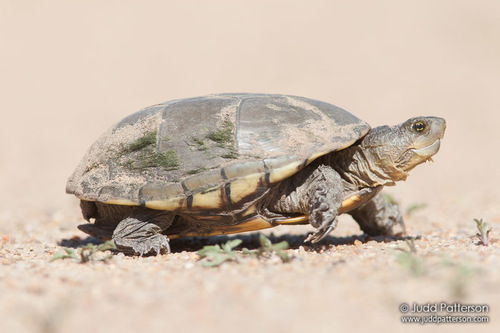
The yellow mud turtle, scientifically Kinosternon flavescens (Agassiz, 1857), is a small, olive-colored turtle. Both its common name and its Latin specific epithet flavescens, which means yellow, reference the yellow markings found on its throat, head, and the sides of its neck. Its bottom shell, called the plastron, ranges from yellow to brown and has two hinges that let the turtle close each end of the plastron separately. Males have a blunt spine at the tip of the tail, while females do not have this spine. This species is distributed across northeastern Mexico, where it occurs in Chihuahua, Coahuila, Nuevo León, and Tamaulipas, and across midwestern and southwestern United States, where it occurs in Arizona, Colorado, Illinois, Iowa, Kansas, Missouri, Nebraska, New Mexico, Oklahoma, and Texas. Its current presence is unconfirmed in Veracruz, Mexico, and Arkansas, United States. Most female aquatic turtles dig a nest in soil near water, lay their eggs, and depart immediately, but yellow mud turtles display parental care behavior. They are the only turtle species observed to stay with their eggs for any length of time. After a female lays a clutch of 1 to 9 eggs, she remains with the eggs for a period ranging from a few hours up to 38 days. Researchers believe the female stays to protect the eggs from predators. Females have also been observed urinating on their nests during dry years, a behavior thought to improve egg hatching success in dry conditions. It is believed that spring rains trigger nesting activity in this species' natural habitat. Eggs hatch in the fall. Some hatchlings leave the nest to overwinter in aquatic habitats, but most hatchlings burrow below the nest and wait until spring to emerge before moving to water. This delayed emergence is thought to boost hatchling survival, because some water bodies freeze completely solid over the winter. A second benefit of waiting to emerge in spring is that hatchlings enter an environment with growing amounts of resources including heat, light, and food.