About Kinosternon creaseri Hartweg, 1934
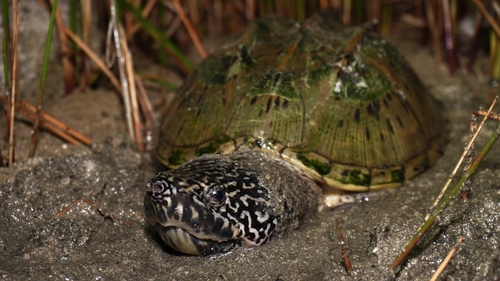
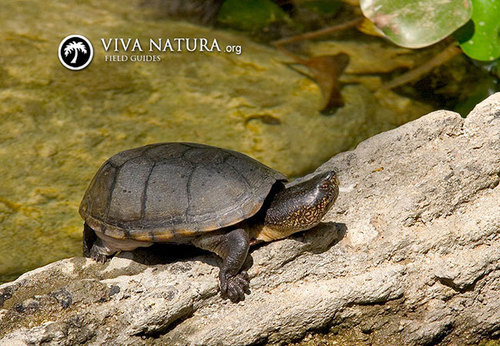
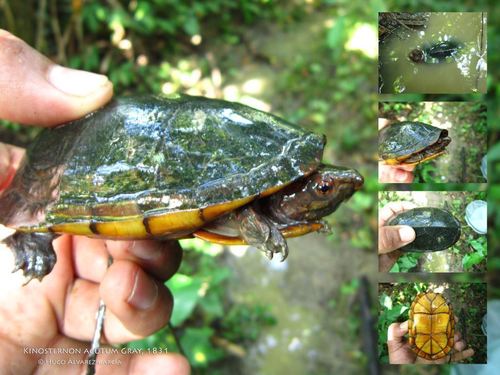
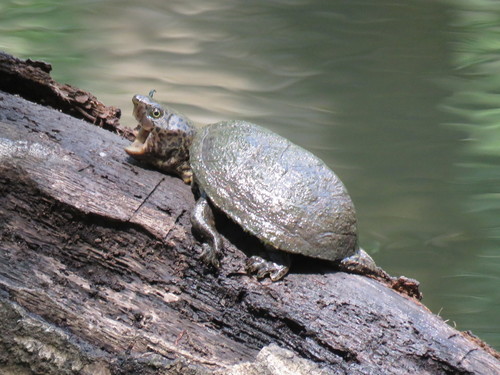
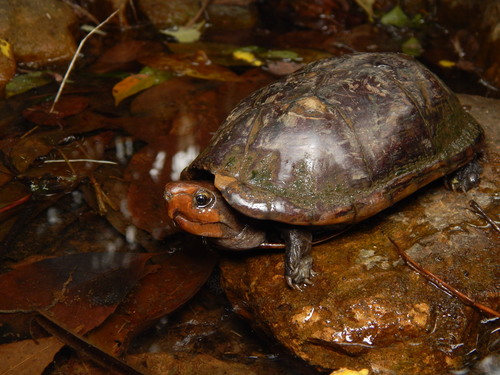
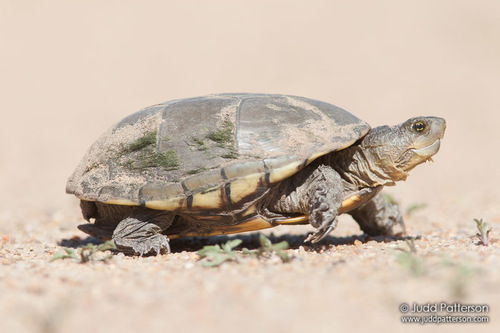
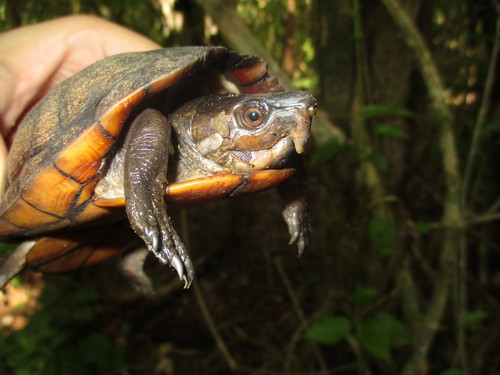
This species, Kinosternon creaseri, commonly called Creaser's mud turtle, is average-sized for its genus Kinosternon. Males grow slightly larger than females, with an average carapace length of 11.5 cm compared to the female average of 10.7 cm. The largest recorded male has a carapace length of 12.5 cm, and males can also be told apart from females by their longer tails. The species can be identified by its distinctive, strongly hooked beak, which is likely not an adaptation for feeding, but instead for aggression. While it can be confused with the scorpion mud turtle, Creaser's mud turtle can be distinguished by its more pungent musk and much more aggressive behavior. When captured, scorpion mud turtles almost always retract into their shells, but both adult and hatchling Creaser's mud turtles will attempt to bite. Additionally, Creaser's mud turtle has a curved seam, rather than a straight one, between the scutes of the plastral hindlobe and the scutes of the fixed mid-portion of the plastron. Its sister species is the Tabasco mud turtle (K. acutum), which Creaser's mud turtle may also be confused with. Kinosternon creaseri is found in the Mexican states of Campeche, Quintana Roo, and Yucatan. A 1988 study found that the densest population occurs in Quintana Roo, since the state had experienced less deforestation than either Campeche or Yucatán. The preferred natural habitat of K. creaseri is small temporary pools of water located in forests, shrubland, and freshwater wetlands, though individuals may occasionally also be found in permanent pools of water. These temporary pools are generally devoid of fish. There is significant geographic variation across the species range. For example, specimens from Quintana Roo typically have dark colored shells, with lighter colored heads and pale yellow necks. This differs from populations elsewhere on the Yucatán peninsula, where shells are lighter in color, and the neck and even parts of the foreleg may be a brighter yellow. Additionally, the plastron morphology of Yucatán specimens differs noticeably from that of specimens from Campeche and Quintana Roo. Kinosternon creaseri is oviparous. It has a small clutch size of only one or two eggs, though each female lays more than one clutch per year. This species lays some of the largest eggs relative to the mother's body mass of any kinosternine species, a trait only rivaled by the Central-American mud turtle, the white-lipped mud turtle, and the Tabasco mud turtle. Hatchling sex is determined by temperature.