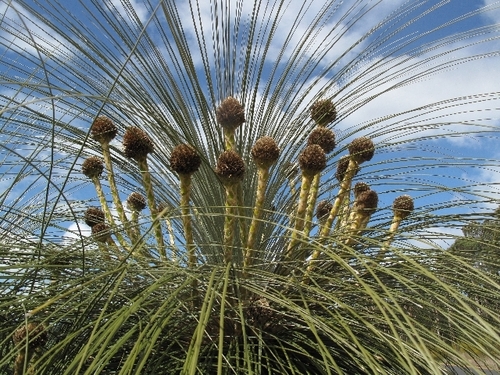
About Kingia australis R.Br.
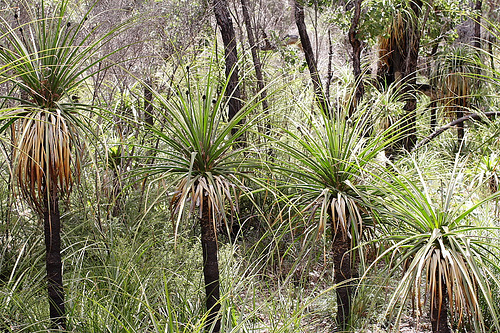
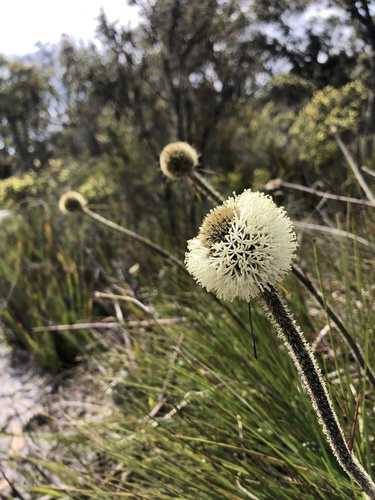
When not in flower, Kingia australis looks superficially similar to species of the genus Xanthorrhoea. However, the flower stalks of K. australis are completely different from those of Xanthorrhoea species, and the two genera are not closely related. For example, Xanthorrhoea have a Dracaenoid secondary thickening meristem in the trunk, while Kingia lacks this feature. Kingia australis is found only in the southern half of Western Australia. Charles Lane Poole, the conservator of forests for Western Australia, identified that this tree has high cellulose content and was exploited for a fibre industry. The fibres obtained from K. australis were used to make brooms and brushes: these included coarse, long-wearing street brooms, and fibres for more delicate uses. Poole recorded that these fibres were preferred by street sweepers working in Perth and Melbourne. The fibres were crudely processed from a layer of material found throughout the plant's trunk. This layer was separated from the soft core, dried to loosen the adhesion between the two parts, then mechanically split and cut to specific lengths with a guillotine, before being baled for export. The genus name Kingia was chosen as the title of the research notes publication produced by the Western Australian Herbarium.