About Kikihia subalpina (Hudson, 1891)
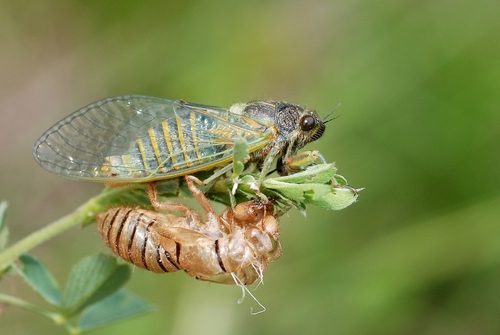
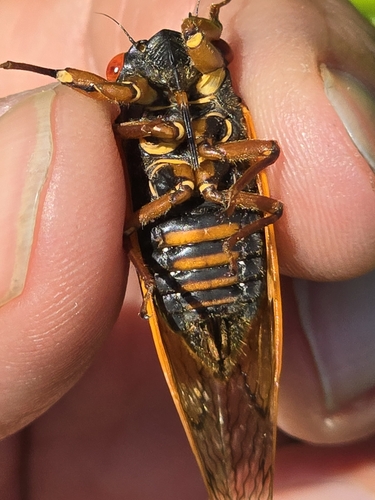
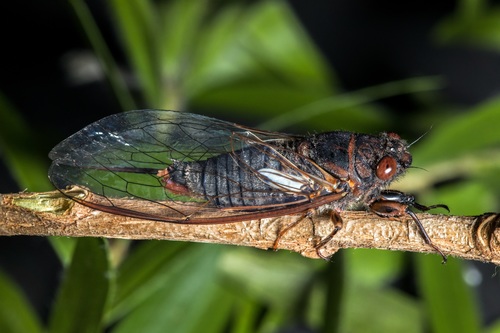
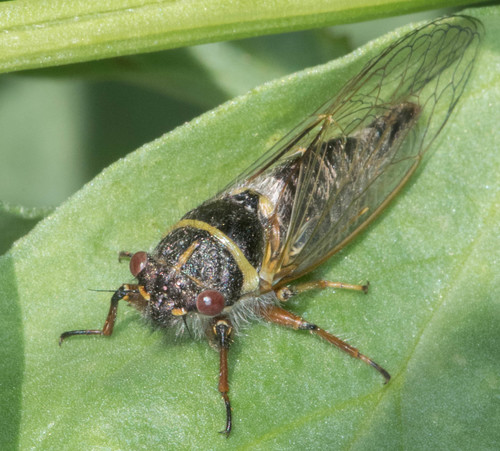
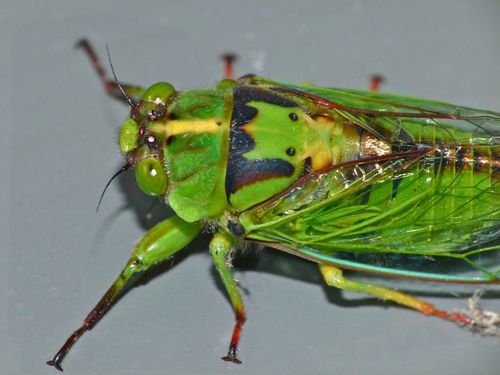
Kikihia subalpina (Hudson, 1891) is generally green overall, with bright green colouring in live individuals. It has lighter markings in the grooves of its pronotum and bold dark markings on its mesonotum, which are often fainter than those seen on K. horologium. Its body has shorter, lighter pubescence than K. horologium. The pronotum features a median yellow line. On the mesonotum, there is a trace of a narrow bright orange-red patch between the nearly touching inner obconical marks. The underside of the head has brownish to purple-pink genae (cheeks) on each side of the frons. The pro- and mesosternum bear nearly triangular black patches. The coxae of the forelegs usually have pinkish red patches. The abdomen usually has a well-defined dorsal median silvery stripe. Male tymbals have 2 long and 1–2 short ridges. The female pygophore generally has a thick black longitudinal mark on each side of the dorsal midline. Body length ranges from 18–22 mm for males and 20–24 mm for females. Wingspread ranges from 46–57 mm for males and 50–62 mm for females. This species is found in New Zealand, across the North Island (Taranaki, Taupo, Hawke's Bay, Gisborne, Rangitikei, Wellington), South Island (Marlborough Sounds, Nelson, Kaikoura, Buller, Westland, Mid Canterbury, South Canterbury, Mackenzie, Otago Lakes, Dunedin, Fiordland), and Stewart Island. Its habitat includes subalpine scrub vegetation (such as Cassinia, Hebe, Phylocladus alpinus, Podocarpus nivalis), and it sometimes also occurs in the canopy of Nothofagus solandri cliffortioides in the central North Island. In the lower North Island, it inhabits scrublands on ridges down to approximately 100 m elevation. In the South Island, it occurs in forest canopy (such as Nothofagus and exotic plantations) from tree line to sea level, and is rarely found in true subalpine environments.